Vietnam was issued a yellow card in October 2017 by the European Fee (EC) due to its faint try to get rid of unlawful, unreported, and unregulated (IUU) fishing. In line with its carding system, the EC has carried out a number of opinions of Vietnam’s fisheries and seafood-related insurance policies and efforts to find out whether or not the yellow card can be maintained or rescinded.
The primary spherical of inspections passed off in Could 2018, however solely resulting in a six-month extension of the yellow card. In November 2019 the EC’s Directorate-Basic for Maritime Affairs and Fisheries despatched inspectors to Vietnam for a second spherical of evaluation, however the consequence didn’t change Vietnam’s yellow card standing.
Shortly afterwards, two digital conferences held between the EC and Vietnam had been organised in June and October 2020, respectively to evaluation Vietnam’s progress. Nevertheless, the consequence disillusioned either side.
EC’s Necessities, Vietnam’s Frustration
The failure of Vietnam’s efforts to take away the yellow card must be ascribed to Vietnam’s restricted progress in bettering fisheries governance and curbing IUU fishing. In different phrases, Vietnam has not successfully enacted all suggestions raised by the EC, together with: (1) Revising the authorized framework to make sure compliance with worldwide and regional guidelines relevant to the conservation and administration of fisheries sources; (2) Making certain efficient implementation and enforcement of nation’s revised legal guidelines; (3) Strengthening the efficient implementation of worldwide guidelines and administration measures; (4) Growing the traceability of its seafood merchandise; and (5) Stopping gross sales of IUU merchandise.
However, as Vietnamese officers have repeatedly said, the federal government of Vietnam has taken strict measures and made important progress in recent times to fulfil the EC’s necessities, similar to (1) Amending the fisheries regulation and strengthening laws; (2) Making a authorized framework for a gradual transition to business, accountable and sustainable fisheries; (3) Lowering the variety of Vietnamese fishing boats working illegally in different international locations; (4) Downsizing the fishing fleet; and (5) Strengthening training and knowledge in order to lift consciousness amongst fishermen to not violate different international locations’ waters.
However why is there such a giant hole between Vietnam’s intentions and actuality? A direct reply is that the effectiveness of Vietnam’s implementation of the related insurance policies to curb IUU fishing is way from anticipated. This begs the following questions: What has triggered the ineffectiveness? What’s the most affordable decision to enhance effectivity?
Elements For Failure
From an financial perspective, Vietnam has suffered huge losses due to the yellow card standing and has a robust must take away it. Latest statistics present that Vietnam’s export of fishery merchandise relied significantly on the European (EU) market, which is without doubt one of the largest export markets for its fishery merchandise. Vietnam’s seafood exports had been valued at US$1.3 billion in 2019, accounting for 15.1 % of its whole seafood exports.
The EU is a market with many strict technical laws on meals security, surroundings and sustainable growth. Vietnamese companies ought to meet the necessities of meals security and hygiene to entry this profitable market, particularly for the reason that formal enactment of the EU-Vietnam Free Commerce Settlement (EVFTA).
High quality is paramount and key to Vietnam’s growth technique for seafood exports. Because of the yellow card for Vietnam’s seafood merchandise, its exports to the EU fell by 6.5 % to US$390 million in 2018 and by 11.5 % to US$345.2 million in 2019 in accordance with its Ministry of Agriculture and Rural Improvement (MARD).
Nevertheless, such financial issues haven’t resulted in a robust impetus for being totally dedicated to curbing IUU fishing. The explanations are multi-faceted.
First, fishing operations by Vietnamese fishermen and fishing boats, both authorized or unlawful have been considered a essential means by the federal government to safeguard its maritime rights. As such, the Vietnamese authorities hesitates to exert all efforts to manage fishing actions, regardless of evoking robust protests from neighbouring international locations due to encroachment of Vietnamese fishing boats into overlapping waters.
Second, exhausting fishery sources, an unsuccessful fishery industrial transition and upgrading has resulted in restricted employment alternatives for native fishermen, who’re pressured to take the danger of conducting unlawful fishing actions for survival.
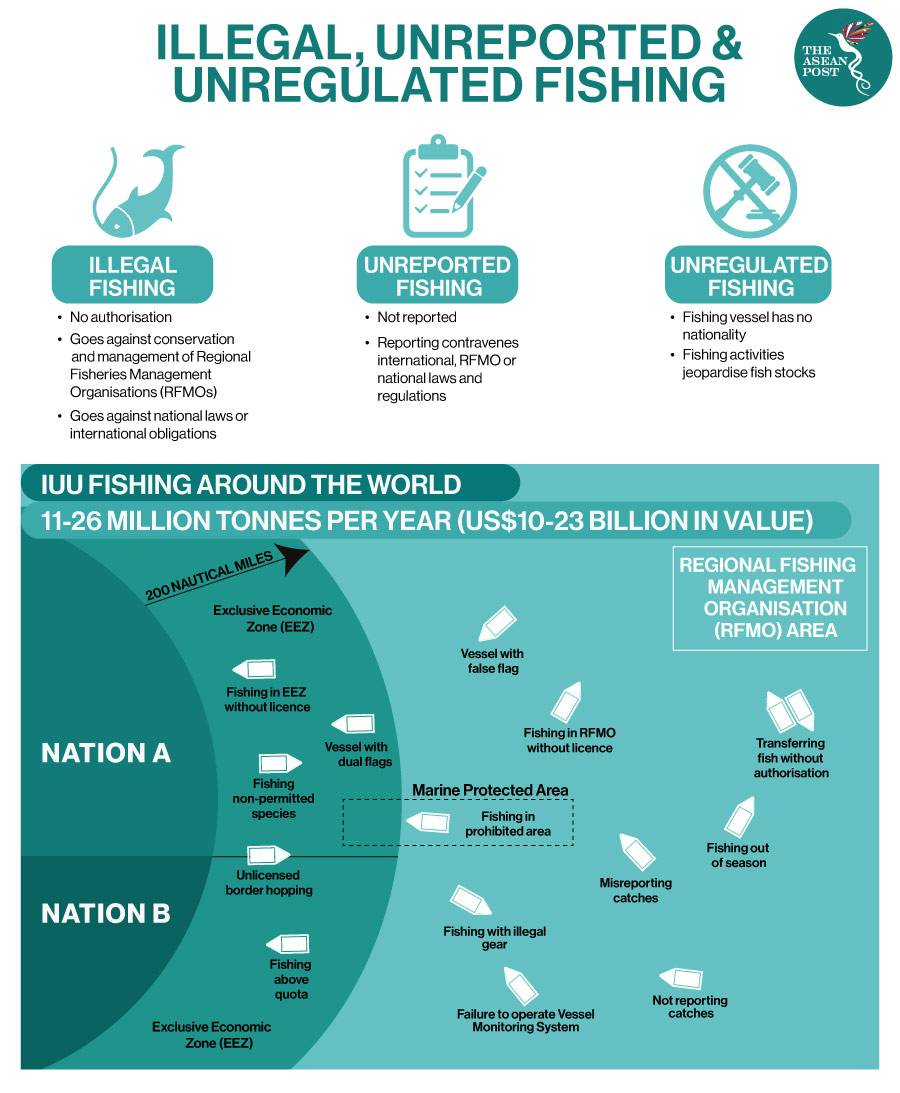
Third, the regulatory authorities generally lack the flexibility to observe IUU fishing on account of monetary and technological components.
Rescinding The Card: New Views Wanted
In brief, Vietnam’s battle with IUU fishing lacks motivation, both politically or socio-economically. Going through previous unsuccessful experiences and present pressures, Vietnam should undertake new pondering.
First, related insurance policies want to start out with multi- and bilateral cooperation moderately than unilateral actions. Unlawful fishing actions have lengthy been a supply of rivalry in regional disputes and flare-ups between regional states. Curbing IUU fishing therefore can’t be carried out unilaterally.
One precondition for efficient cooperation with neighbouring international locations is to take care of the steadiness at sea. It’s thus vital for Vietnam to desert the concept that encroaching into disputed waters by Vietnamese fishermen is a way of safeguarding its maritime sovereignty. Maritime disputes can solely be solved by means of negotiation below worldwide legal guidelines such because the United Nations Conference on the Legislation of the Sea (UNCLOS).
On this regard, collectively supporting the institution of an IUU fishing fight community is within the curiosity of all states across the South China Sea. In any other case, it could be troublesome to successfully cope with the unlawful actions of Vietnam’s fishing vessels.
Second, pursuing modern approaches in bettering the dwelling requirements of fishermen is important for lowering their dependence on unlawful fishing. At the moment greater than half of Southeast Asia’s inhabitants depend on fisheries and aquaculture for his or her livelihoods and the identical will be stated for Vietnam.
Because of the continuously exhausted fishery sources, it’s comprehensible that native fishermen will proceed utilizing unlawful strategies to extend their catch. Coverage-makers have to think about the best way to diversify their revenue sources. Deep-sea farming and aquaculture must be inspired. Superior processing industries will be established to improve the export construction with value-added fishery and seafood merchandise aimed on the EU market.
Third, introducing excessive know-how to optimise current monitoring techniques is important in tracing IUU fishing. Though Vietnam has made nice efforts in putting in fishing vessel monitoring techniques based mostly on the EC’s suggestions, solely about 30 % of all Vietnamese fishing boats have been geared up with such services.
Furthermore, future IUU fishing hint and suppression want the Vietnamese authorities to use high-tech services and infrastructure, similar to an IT-driven danger administration system, big-data evaluation, wi-fi sensor networks, and so forth. This requires the Vietnamese authorities to allocate extra funds and sources for analysis and growth. On this regard, collectively growing a complicated and shared monitoring system by regional states can be extra cost-efficient.
In fact, all events ought to keep in mind that curbing IUU fishing is a time- and resource-consuming course of. Some students have argued that regional states’ efforts to fight IUU fishing are seldom totally evaluated. Some analysis establishments additionally emphasise an excessive amount of on the established order, lowering the curiosity of the EC and different international locations in making optimistic progress in follow.
However, to take away the yellow card, Vietnam has to insist on co-operation, transparency and honesty in offering and exchanging info relating to curbing IUU fishing. Solely on this manner can Vietnam harvest the advantages of intensive environmental, financial and diplomatic advantages.
Associated Articles:
Vietnam Joins ASEAN Effort To Combat IUU Fishing