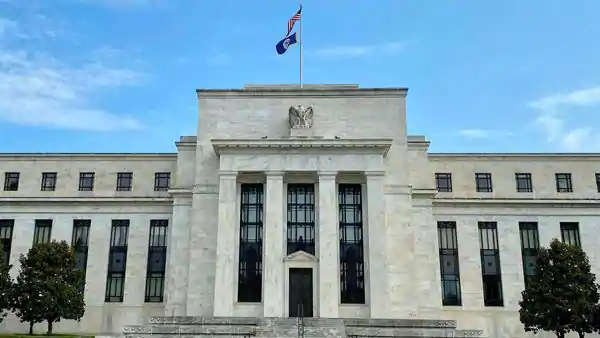


A typical thread runs by these scenes from the plague yr 2020: Low cost cash, gushing in from the world’s main central banks, inflated belongings and reshaped how we save, make investments, and spend. And that’s not the tip of it. Not like previous recoveries, when traders had no readability on when the financial faucets can be tightened, this time officers have explicitly mentioned they’re going to stay to their unfastened insurance policies nicely right into a post-Covid restoration.

View Full Picture
The technique is evident and deliberate: Snuff out volatility from the bond market and make debt the most affordable it’s ever been to discourage saving and encourage funding. The hope: Low cost money leads corporations to take a position and rent as rising asset costs make individuals extra assured and able to spend. The inevitable aspect impact: Extra volatility for belongings (other than bonds) as traders chase returns all over the world. And, in fact, the danger: Bloated asset costs pop, undermining monetary stability earlier than the true economic system can profit from all that money.
“There isn’t a escaping that if you happen to improve liquidity dramatically, the cash will go in seek for yield and positively can expose belongings to mispricing,” says Agustín Carstens, common supervisor of the Basel, Switzerland-based Financial institution for Worldwide Settlements, the so-called financial institution for central banks. “This can be a threat and one thing that must be acknowledged and that must be watched very, very fastidiously.”
Indicators of bubbles are in all places as inventory costs jumped by a magnitude not seen for the reason that dot-com period, new share listings growth, and Bitcoin, although unstable, continues its typically upward climb. But when firm earnings fall wanting expectations or the vaccine rollout falters, there’s a threat markets will lurch as traders take cash off the desk.
Central bankers, from the US Federal Reserve’s Jerome Powell on down, are nicely conscious of the hazard. Surging valuations—some traders name what’s occurring “the every little thing rally”—have been too apparent to disregard. Powell, Financial institution of Japan Governor Haruhiko Kuroda, and different main central bankers, although taken to activity about bubbles in markets in current months, have performed down the issues. That’s partly as a result of they’re conscious of the hazard of closing the financial spigot too rapidly. Certainly, popping out of the final disaster a decade in the past, policymakers in some economies had been in all probability too fast to withdraw stimulus for concern of making bubbles and ended up placing the brakes on the financial restoration.
When the pandemic’s unfold led to shutdowns throughout a lot of the world, most central banks went all in. They slashed optimistic rates of interest to close zero; the place charges had been already razor-thin, they massively elevated asset purchases; many arrange emergency funding for struggling corporations; and this time most pledged to maintain their unprecedented settings for the subsequent few years. Throughout 2020, governments rolled out no less than $12 trillion in fiscal stimulus, based on the Worldwide Financial Fund, and central banks supplied trillions extra in financial assist.
It labored. World bond markets that confirmed alarming indicators of dislocation final March turned calm. Inventory markets rallied. Currencies in rising markets strengthened, letting their central banks get in on the easing act, too. The end result has been terribly low yields even for the longest-dated debt securities and historically riskier debtors.

View Full Picture
As of Dec. 31, $17.8 trillion in debt was buying and selling with a destructive yield. Governments from Australia to Spain had been successfully getting paid to borrow. Junk bonds within the US had been buying and selling at yields much like these of investment-grade company debt that priced simply two years earlier. When Peru bought a debut 100-year bond in November, the instrument grew to become the lowest-yielding safety of such maturity ever issued by the federal government of a creating economic system.
“Central banks, and particularly the Fed, have already created bubbles,” says Alicia García-Herrero, chief Asia-Pacific economist at Natixis SA in Hong Kong, who beforehand labored for the IMF and the European Central Financial institution. She factors to the disconnect between booming markets and a really uneven financial restoration. “Central banks know what they’re doing—principally decreasing the return of protected belongings to extend demand for dangerous ones. When you do this, you understand a bubble may seem, however the price of not doing something might be even greater.”
When the public sale of seven homes met with frenetic bidding in Wellington in November, a modest 80-square-meter, three-bedroom cottage went for NZ$945,000 ($678,000)—nicely above the so-called rateable valuation of NZ$640,000 assessed by the native authorities. “Rates of interest traditionally have by no means been decrease,” says Harper, the auctioneer. “So it’s simple for patrons to borrow.”
Whereas New Zealand’s central financial institution had managed to skirt the worldwide monetary disaster with out resorting to quantitative easing, the pandemic blew that up. The Reserve Financial institution of New Zealand lower rates of interest and launched a bond-buying program—the affect of which, coupled with a provide scarcity, lit up the nation’s home costs. With rock-bottom borrowing prices stoking demand for properties, the federal government took the bizarre step of asking the RBNZ to take the housing market under consideration when it units its insurance policies—a transfer the financial institution resisted.
Bidding for his or her first house, Harriette McClelland and Harry Greenwood, each of their late 20s, missed out when the value approached NZ$1.2 million. “I’m disenchanted,” McClelland mentioned on the time. She pinned among the blame on a scarcity of provide, including, “however clearly low rates of interest have actually escalated issues rather a lot.”

View Full Picture
That disappointment is mirrored globally as inequality deepens throughout completely different inhabitants teams. Homeowners of appreciating belongings are having fun with hearty beneficial properties in wealth, whereas these with out them are lacking out.
The world’s 500 richest individuals added $1.8 trillion to their mixed web price final yr, taking it to $7.6 trillion, based on the Bloomberg Billionaires Index. Till January, Amazon.com Inc. founder Jeff Bezos remained the world’s richest individual, because of surging enthusiasm for on-line retail throughout lockdown. Then, in presumably the quickest bout of wealth creation in historical past, Elon Musk leapt into first place after Tesla Inc. skyrocketed in worth. Mixed, these two males gained about $217 billion in 12 months, sufficient to ship $2,000 checks to greater than 100 million People.
Critics say central bankers are deepening inequality by whipping markets to frothy heights whereas doing little for wage beneficial properties or job creation in the true economic system. Then again, there’s the argument that ultimately, financial coverage is proscribed in what it may well do to heal a shattered economic system. Reserve Financial institution of Australia Governor Philip Lowe acknowledged as a lot in testimony to lawmakers in Canberra in December: “All I can do is attempt to make the mixture robust,” he mentioned.
What’s wanted as an alternative is extra authorities spending, based on the likes of former US Treasury Secretary Lawrence Summers and former Council of Financial Advisers chair Jason Furman. Democratic lawmakers have been urgent the Fed to revive initiatives it launched to assist smaller companies and municipalities. For his or her half, Republican lawmakers have sought to restrict the flexibility of the Fed to make use of nontraditional coverage instruments; in late 2020 they pressured a phaseout of 5 emergency lending amenities, auguring additional political battles, particularly if asset worth inflation continues. The administration of Joe Biden may have an opportunity to assist form the talk as he fills appointments on the Fed board.
There’s little question that huge financial injections have made it simpler for cash-strapped governments to fund finances deficits. They’re killing bond vigilantes, these traders who demand a higher return, particularly for longer-dated securities, when a authorities’s borrowing soars to compensate for the added threat in being paid again. These days central banks—explicitly within the case of Japan and Australia or implicitly within the case of the U.S. and a few others—are damping even long-maturity yields with steerage that assures extended simple cash.
Fed Chairman Powell alluded to the dynamic in a Dec. 16 press briefing when commenting on hovering U.S. shares and their elevated price-to-earnings ratios. “Admittedly, PEs are excessive,” he mentioned. “However that’s perhaps not as related in a world the place we predict the 10-year Treasury goes to be decrease than it’s been traditionally from a return perspective.” He spoke after the Fed linked its stability sheet growth to attaining progress towards its inflation and employment objectives—a marked evolution from the spring of 2020, when it was designed to avert a lockdown-induced credit score squeeze.
For Paul Nolte, a portfolio supervisor at Kingsview Asset Administration LLC in Chicago, Fed coverage has been the important thing think about his decision-making prior to now yr. When it grew to become clear final spring that financial coverage was driving to the rescue, he says, it “was a second of ‘aha, right here comes the Fed.’ ” Beginning in April, after financial authorities started pumping liquidity into markets, he piled into high-yield bonds together with investment-grade credit score and equities.
By {the summertime}, he discovered himself fielding calls from purchasers who had been alarmed at his bullish market positioning, given mounting worries over a coronavirus resurgence. “A few of them referred to as and mentioned, ‘It’s too dangerous, we have to go to money,’ ” Nolte says. “They couldn’t perceive what stored the inventory market going. I’d inform them, ‘The important thing to that’s the Fed. You need to take note of the economic system, however you want to pay much more consideration to the Fed.’ ” Later within the yr he was nonetheless favouring riskier belongings, turning towards sectors together with small-cap shares and rising markets.
On the identical day in December that Powell gave his stimulus assurance, Bitcoin breached $20,000 for the primary time, en path to a 2020 acquire of 305%. Scott Minerd of Guggenheim Investments advised Bloomberg TV that the truthful worth of the world’s largest cryptocurrency nonetheless had a strategy to go. Its shortage and “rampant cash printing” by the Fed recommended Bitcoin would ultimately climb to about $400,000, Minerd reckoned—although he tempered his enthusiasm in January, after Bitcoin slid as a lot as 21% over a few days, saying, “Bitcoin’s parabolic rise is unsustainable within the close to time period.”
Whereas established crypto-traders stay the key drive behind Bitcoin’s transfer, newcomers to the digital market together with large corporations and Wall Road traders are additionally an element, says Hong Kong-based Bankman-Fried, who based the derivatives change FTX and in addition heads the crypto-buying and selling agency Alameda Analysis. “The low-yield setting is main extra corporations to say, ‘Let’s put our cash in Bitcoin,’ ” he says. “I’m working 17, 18 hours a day and taking naps once I can within the workplace. All of our metrics are means up.”
Bubbles aren’t an financial drawback till they pop. Environment friendly markets ought to worth sooner or later, so rallying shares, home costs, bonds, and Bitcoin might all be signaling a sturdy growth as the worldwide economic system shakes off the coronavirus shock. “The most important threat is that the capital markets central banks don’t management begin to misbehave,” says Michael Shaoul, chief government officer at Marketfield Asset Administration LLC. The medium-term pledge from central banks forswearing tightening, he says, “has already been priced into many monetary choices.”
One instance: Non-public fairness and different nonpublic traders have poured into industrial actual property even because the pandemic has raised questions on the way forward for cities. Regardless of its publicity to malls, eating places, motels, and workplaces that will face decrease long-term income in a post-Covid world, industrial property has been rebounding. Premiums on U.S. BBB-rated industrial property bonds nearly halved between Might and the tip of 2020, based on information Bloomberg compiled. That was regardless of delinquency charges on industrial mortgage-backed securities that as of November weren’t bettering, based on Goldman Sachs Group Inc. For securities tied to lodging, the delinquency price was nearly 23%, and for retail it was 12%, based on a mid-December Goldman report.
With traders chasing returns wherever they’ll discover them, the rising tide of cash is flowing by to bonds bought by corporations from poorer economies, too. That is the case even in nations which have been among the many hardest hit by the pandemic. When AC Power, a part of Philippine conglomerate Ayala Corp., bought a $300 million perpetual inexperienced bond at 5.1% in November, CFO Dizon described the demand as “overwhelming.” Vaccine optimism, together with expectations for a robust restoration in 2021, helped clear the route for AC Power’s fundraising. “Within the morning we introduced the mandate and within the night we priced,” she says. “That often takes two days. However we noticed that the market was very robust, so our bankers really useful to simply shut every little thing within the day.”
For all of the market optimism that abounded as the brand new yr started, one factor was clear: The worldwide economic system will want a strong restoration to justify lofty valuations in international inventory markets.
In October, high-flying equities persuaded Einhorn’s Greenlight Capital to guess towards what he referred to as a “bubble basket of principally second-tier corporations and up to date IPOs buying and selling at outstanding valuations.” However to those that suppose that central financial institution stimulus is a stable basis on which to make bets, Einhorn says the historical past of financial coverage in Japan and Europe exhibits that “artificially managed long-term rates of interest are not any justification for stratospheric fairness valuations.”
The surge in equities for the reason that monetary system’s darkest days in late March of final yr—an advance that noticed the S&P 500 index soar 68% from its low that month to the tip of the yr—additionally had corporations dashing to benefit from flattering valuations. Preliminary public choices raised about $180 billion on U.S. exchanges in 2020, greater than double the prior yr’s whole and much above the earlier excessive of $102 billion set in 2000, based on information Bloomberg compiled. That included some blockbuster debuts, resembling Airbnb Inc. greater than doubling, up 113%, on its first day of buying and selling, and DoorDash Inc. leaping 86%.
The IPO wave was additionally powered by a brand new funding construction involving so-called special-purpose acquisition corporations that’s turn into more and more standard in recent times. SPACs elevate cash by public choices, utilizing the funds to purchase stakes in goal corporations they establish after they’re listed.
Till pretty lately, these corporations targeted on “worth” sectors, the place belongings are perceived to be underpriced. Then got here 2020. Not solely did a file variety of SPACs come to market, however 31% of them didn’t even specify an trade they had been concentrating on, based on Goldman analysts led by David Kostin in a December report. Whole proceeds greater than quintupled. From the beginning of July by mid-December, the market averaged multiple SPAC IPO a day. “With the Fed dedicated to holding the funds charges close to zero, our view is that SPAC exercise will proceed at a excessive tempo in 2021,” the report mentioned.
Amid all of the rippling results—from central banks to authorities bonds to equities, actual property, and rising markets—essentially the most worrying dynamic for a lot of is the explosion of recent debt, each private and non-private. Borrowing grew $15 trillion within the first three quarters of 2020, to a file of greater than $272 trillion, based on the Institute of Worldwide Finance. The Washington-based group warns that emerging-market debt, excluding banks, is rapidly approaching 210% of gross home product, up from 185% in 2019 and 140% a decade in the past. The concern is that falling revenues will make paying again that debt more durable, even with low rates of interest.
If inflation rises and central banks are pressured to dial again on easing, then bond markets globally will really feel the ache, even perhaps derailing any restoration. The Taper Tantrum of 2013 is illustrative. When then-Fed Chairman Ben Bernanke introduced a future tapering of his quantitative easing program, U.S. Treasury yields shot greater, roiling markets all over the world. This time across the exit ramp will probably be much more fraught with hazard, given the bigger scale of stimulus.
Even when issues do work out as presently envisaged, there are dangers. Japan is an instance of the sorts of challenges that crop up if financial coverage stays caught in place for a very long time. Japanese traders have been successfully pressured out of their nation’s authorities bond market by the Financial institution of Japan’s voracious QE, destabilizing establishments that historically relied on parking investments in these securities, particularly regional banks.
The Yoshihide Suga administration is working with the BOJ to rationalize the whole regional banking trade to move off probably disruptive collapses in coming years. Different large traders, together with the huge financial savings system run out of publish workplaces, have turned to abroad investments, leaving them susceptible if the yen appreciates and makes overseas belongings price much less in home phrases.
One other weak point highlighted by Japan’s generation-long experiment with ultra-easy financial settings is that the quantitative easing has undermined longer-term productiveness by propping up companies that in all probability ought to’ve been allowed to fail. That’s what occurs when governments and firms can borrow so cheaply that there’s no incentive to make structural fixes that inflict short-term ache resembling job losses.
“Central banks [in advanced economies] are in a worldwide liquidity lure,” says Jerome Jean Haegeli, chief economist on the Swiss Re Institute in Zurich. “The liquidity bazooka buys time and pushes up asset costs however has zero worth in bettering financial development development. Like a black gap, as soon as you’re in it, this can be very tough to get out. That’s the place we’re in central banking, we’re in a liquidity black gap.”
The time for max bullishness—when coveragemakers are going all-out to jump-start their economies—could also be coming to an finish, leaving a trickier interval looming on the horizon, says Richard Yetsenga, the chief economist of Melbourne-based Australia & New Zealand Banking Group Ltd. “Whereas the danger profile for development has been declining,” he says, “for asset costs and monetary stability, it’s going to quickly be growing.” —With Matthew Brockett, Katherine Burton, Elena Popina, Tassia Sipahutar, and Cecilia Yap
Anstey is a senior editor in Boston and Curran is chief Asia economics correspondent in Hong Kong.