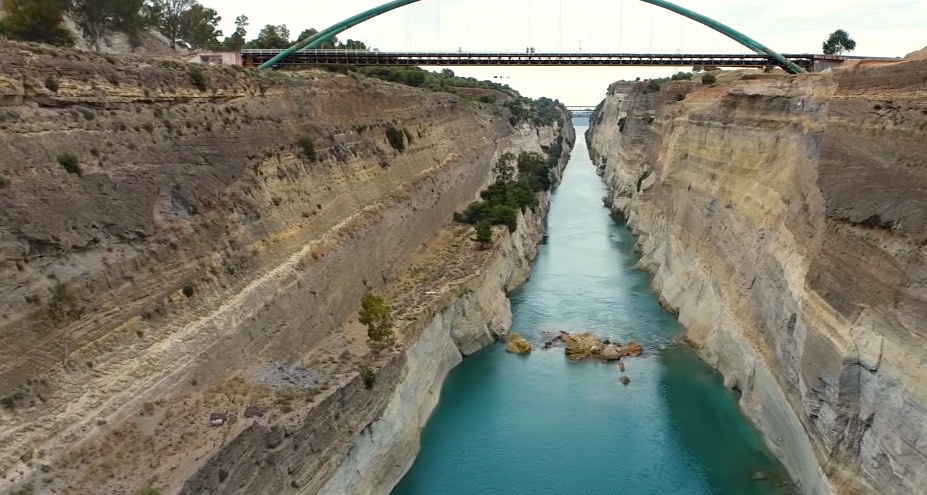
The Corinth Canal, one of the necessary infrastructure works of contemporary Greece which fully revolutionized its maritime exercise, has remained closed to maritime site visitors since January 2021.
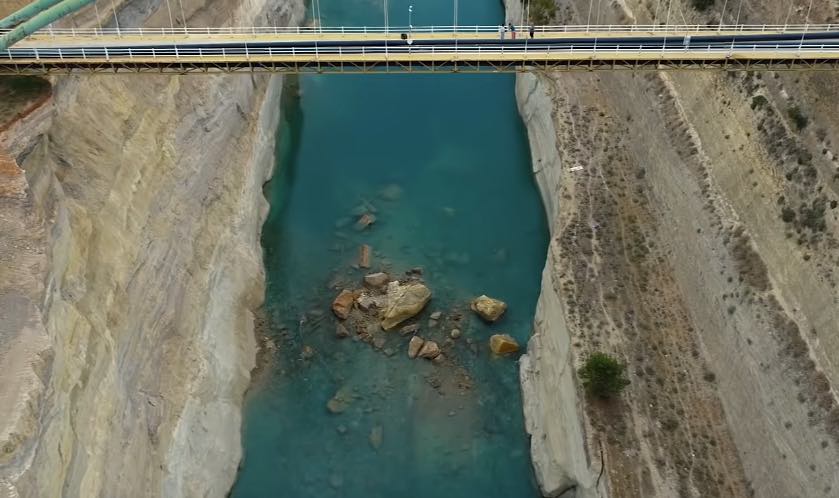
The Canal suffered harm as a result of landslides at the moment, making maritime passage unattainable. Restore work is at present underneath approach, however there isn’t any clear timetable as to when it is going to be accomplished.

A brand new video by Up Tales exhibits the lengthen of the harm within the canal. Big rocks and particles are clearly seen in the course of the canal, blocking transit.
In accordance with the research carried out to this point by the Ministry of Infrastructure & Transport, moisture and erosion prompted the lack of the stone piers that supported and guarded the bottom from falling into the canal.
The preliminary work on the research is predicted to be accomplished in September. Then the development for the challenge will go up for bid, and the preliminary works on the edges of the Canal will start subsequently.
As Greece has opened to tourism this summer season, hundreds of tourists who move by way of from the Ionian to the Aegean Seas on yachts and cruise ships will both should cancel or take the lengthy and far costlier route across the Peloponnesian peninsula.
As well as, in fact, business shipping in Greece is already struggling as the price of transporting items and gas are growing. Economists concern that this may increasingly lead to medium to long-term worth will increase.
The way forward for the operator of the Canal and its staff can also be at stake, as revenues have now fully dried up.
Corinth canal modified maritime routes
The Corinth Canal was opened to be used on July 25, 1893.
Often known as the Isthmus of Corinth, the canal connects the Ionian and the Aegean making the passage of cargo and passenger ships between the 2 seas a lot faster.
Building works began in 1882 and the canal was formally opened by then Prime Minister Sotirios Sotiropoulos, however it was envisioned and accomplished by his predecessor Harilaos Trikoupis, whose time period had ended simply two months earlier than that date.
Earlier than the canal was constructed, ships from the Ionian Sea with the vacation spot of Athens or the Aegean islands needed to go all the way in which across the Peloponnesian peninsula and vice versa.
After 1893, cargo and passenger ships would solely should cross the Corinth Canal and attain their vacation spot rather more rapidly.
The phrase “isthmus,” which comes from the Historical Greek phrase for “neck,” refers back to the narrowness of the land.
Historical Greeks tried to construct canal
The thought for a shortcut to avoid wasting boats from the perilous journey of crusing all the way in which across the Peloponnese was lengthy thought-about by the Historical Greeks.
The primary try to construct a canal there was carried out by the tyrant Periander within the seventh century BC.
He deserted the challenge owing to technical difficulties, and as an alternative constructed an easier and less-costly overland stone road named the Diolkos, as a portage highway. Components of the Diolkos nonetheless exist right now subsequent to the fashionable canal.
When the Romans took management of Greece, various totally different options had been tried as a method to allow passage from the Ionian to the Aegean. Julius Caesar himself foresaw some great benefits of a hyperlink for his newly-built Colonia Laus Iulia Corinthiensis.
By the reign of Tiberius, engineers tried to excavate a canal however had been unable to succeed as a result of a scarcity of powerful-enough gear.
As a substitute, they used an historical Egyptian machine: boats had been rolled throughout the isthmus on logs, because the Egyptians had rolled blocks of granite to make their pyramids.
In 67 AD, the Roman emperor Nero ordered 6,000 slaves to dig a canal with spades. Historian Flavius Josephus wrote that the 6,000 slaves had been Jewish pirates, taken captive by Vespasian in the course of the Jewish wars.
In accordance with Pliny the Elder, the work superior 4 stadia (about 0.8 kilometers). The next 12 months Nero died, and his successor Galba deserted the challenge as being too costly.
Within the trendy period, the concept was first severely proposed in 1830, quickly after Greece’s independence from the Ottoman Empire.
The Greek statesman Ioannis Kapodistrias employed a French engineer to place collectively a sensible challenge — which ended up with an estimated steep worth of 40 million gold francs — making Greece abandon the pricey challenge as soon as once more.
Suez Canal served as inspiration for the Corinth canal
Quickly after, impressed by the development of the Suez Canal, Prime Minister Thrasyvoulos Zaimis signed a legislation in 1870 that licensed the engineering challenge for the Corinth Canal.
A French firm oversaw the challenge that resulted within the building part beginning and shortly after ending — once more as a result of value points.
The dream of the Corinth Canal would lastly develop into a actuality when in 1881, the Société Internationale du Canal Maritime de Corinthe was commissioned to assemble the canal and to function it for the subsequent 99 years.
Building started in April 1882; nevertheless, eight years later, Greece ran out of cash. This time, a Greek firm stepped in and the canal was lastly accomplished in July of 1893.
To the west of the Isthmus is the Gulf of Corinth, to the east the Saronic Gulf. Since 1893 the Corinth Canal has run by way of the 6.3 km (3.9 mile) vast isthmus, successfully making the Peloponnesian Peninsula an island.
Right this moment, two highway bridges, two railway bridges and two submersible bridges at each ends of the canal join the mainland facet of the isthmus with the Peloponnesian facet. As well as, a navy emergency bridge is situated on the west finish of the canal.