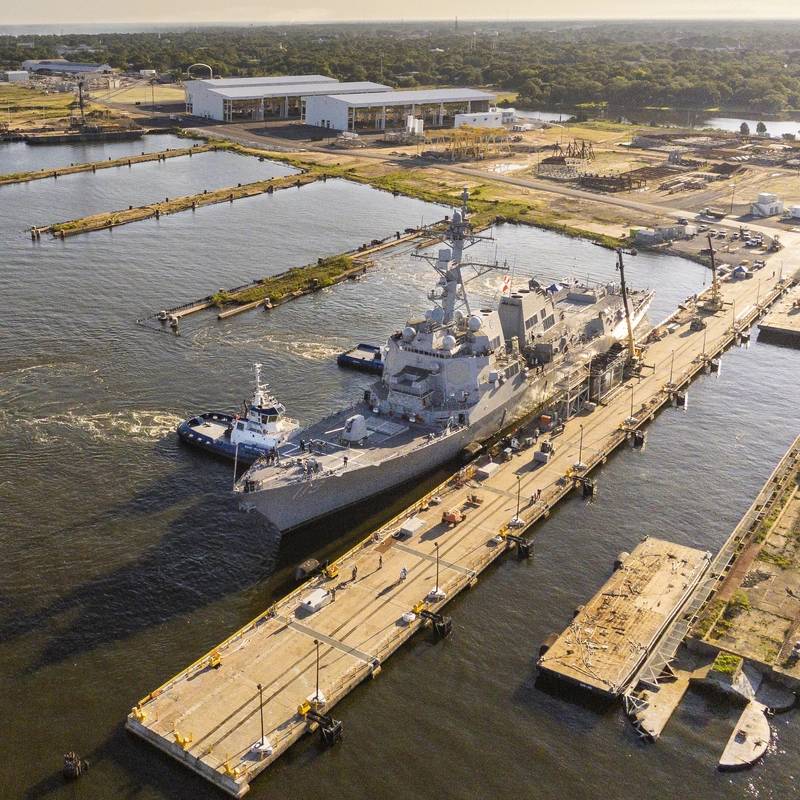
America is residence to a number of the most interesting shipbuilders on the earth. This business is turning into more and more very important to our nationwide safety as we search to construct a bigger Navy able to confronting China. Sadly, our shipyards are growing old and are too small to broaden our fleet on the tempo that’s wanted. As lawmakers think about what to incorporate in an upcoming infrastructure invoice, I’m main a bipartisan effort to supply a major enhance to infrastructure at our nation’s shipyards.
My proposal, referred to as the SHIPYARD Act, would supply $25 billion to enhance shipyards, together with $21 billion for the Navy’s 4 public yards and one other $4 billion for personal development and restore yards like Ingalls Shipbuilding and VT Halter in Mississippi. I’m inspired by the rising bipartisan assist for the SHIPYARD Act and hope it will likely be included as a part of an infrastructure bundle.
Shipyards want greater, extra fashionable amenities
In 2017, Congress handed the SHIPS Act, laws I authored making it the coverage of the US to construct a 355-ship Navy as quickly as practicable. This was an essential step, however Congress now must clear away obstacles to reaching this objective. Our shipyards of their present state are struggling to service our present fleet of 296 ships, not to mention the large fleet we have to compete with our adversaries.
The Navy owns and operates 4 shipyards, that are answerable for sustaining our plane carriers and submarines. All 4 of those amenities are greater than 100 years outdated and in determined want of upgrades. Getting older gear and a scarcity of usable restore docks have brought about lengthy upkeep delays, leading to fewer ships being prepared for deployment. This gradual course of has saved us from constructing our fleet in a well timed method and allowed China to start difficult American supremacy at sea.
China’s shipyards allow Beijing to venture energy
China has develop into our major strategic rival and can doubtless stay so for the foreseeable future. Though our army enjoys technological benefits, China’s Navy has eclipsed ours by way of sheer dimension, surpassing 350 ships. China has achieved this huge naval pressure by dramatically increasing its shipbuilding and upkeep base, with greater than 1,000 shipyards now supporting its sprawling fleet. America has vital floor to make up.
The Navy has been doing the perfect it may with the sources at its disposal. In 2018, the Navy launched a 20-year plan for revitalizing its shipyards. However 20 years is way too lengthy to fulfill our urgent safety wants.
The SHIPYARD Act would assist velocity up the Navy’s plan by funding it , with appropriations that will not expire on the finish of any fiscal yr. This might give the Navy flexibility to ramp up operations on essentially the most environment friendly timeline potential. The Navy would be capable of put these funds towards tasks at a spread of amenities, together with main shipyards and the various contractors and suppliers that assist construct U.S. Navy ships.
Shipyards usually are not our army’s solely infrastructure want, however they’re the supply of our nation’s sea energy and are taking part in an more and more pivotal position within the world steadiness of energy. As Congress considers what infrastructure priorities will finest serve our communities and advance our nationwide safety, our nation’s shipyards have to be a precedence.
The writer
Roger F. Wicker has represented Mississippi within the U.S. Senate since December 2007. He’s the rating member of the Senate Committee on Commerce, Science, and Transportation for the 117th Congress and the second-highest rating Republican member of the Senate Armed Companies Committee. His different committee assignments embody the Surroundings and Public Works Committee; and the Guidelines and Administration Committee. He additionally serves as a member of the U.S. Service provider Marine Academy Congressional Board of Guests.
Within the one hundred and fifteenth Congress, Wicker authored the “Securing the Homeland by Growing our Energy on the Seas (SHIPS) Act,” which made it the coverage of the US to realize the Navy’s requirement for a 355-ship fleet. This laws, which was designed to bolster nationwide safety and enhance American shipbuilding capability, was signed into regulation by President Trump as a part of the Nationwide Protection Authorization Act.
Previous to his service within the Senate, Wicker was elected seven instances, starting in 1994, to characterize Mississippi’s First Congressional District within the Home of Representatives. Earlier than being elected to Congress, he served within the state Senate on behalf of Lee and Pontotoc counties. Senator Wicker served on energetic responsibility within the U.S. Air Power after which joined the Air Power Reserve. He retired from the Reserve in 2004 with the rank of lieutenant colonel.