
The current strikes in EUR/USD have largely adopted these of the greenback, with increased treasury yields propelling the buck increased. We mentioned on this article how we anticipate the pair to react to additional upward swings in US charges. A 5.0% 10-year yield would carry EUR/USD to 1.02, by our calculations. On the similar time, some idiosyncratic bearish drivers for the euro have not too long ago began to emerge, largely associated to the deteriorating financial outlook within the eurozone.
Eurozone peripheral spreads have, to this point, not been a part of that set of idiosyncratic dangers for the euro. Not too long ago, although, the Italian BTP-German bund 10-year unfold has jumped and briefly touched 200bp after the Italian authorities introduced the 2023 fiscal deficit at 5.3% of GDP, up from the 4.5% April goal.
On this word, we have a look at how the BTP-bund unfold has traditionally impacted the euro and the way this time could also be completely different given the European Central Financial institution’s Transmission Safety Instrument (TPI) backstop.
The Italian price range backdrop and dangers forward
The disclosure of some numbers from the updating word to the financial and monetary doc (NADEF), which units the macro framework for the following Italian price range, didn’t provide massive surprises with respect to what had been leaked over the previous week – nor to what we had anticipated. In keeping with the numbers out there, the federal government has taken inventory of a deteriorating financial setting, trimming development forecasts and making specific the affect of the so-called “tremendous bonus” tax credit score on present deficit and future debt.
In keeping with the press launch, the fiscal push to be funded in deficit – as proxied by the distinction between the development deficit and the deliberate deficit – will quantity to 0.7% of GDP in 2024, a related however not big quantity by historic requirements.
Debt stabilisation appears to be the primary concern, and rightly so, provided that we don’t know but which fiscal rule might be in place beginning January 2024. Nevertheless, the very restricted room for manoeuvre that the projected debt dynamics go away to the federal government represents a possible supply of political dangers. Firstly, inside the governing alliance, as scarce sources is not going to enable formidable electoral guarantees to be met on this budgetary spherical; secondly, between the Italian authorities and the EU Fee, ought to complaints on the surplus of EU controls solicit pro-cyclical reactions on the EU aspect.
By the top of October, the Italian authorities should submit the draft price range to Brussels. Developments in negotiations on the reform of the steadiness pact might assist to scale back background uncertainty and make this price range season an orderly one.
Peripheral spreads and TPI
Eurozone peripheral spreads have typically declined for the reason that introduction of the ECB’s TPI in mid-2022, though we have now been observing a modest rebound in Spain and Italy’s spreads prior to now weeks. As proven within the chart under (Spain’s unfold on the right-hand axis), any actual concern could be confined to the Italian bond marketplace for now.
Italy’s bond market underperformance is no surprise. The nation’s longstanding debt sustainability considerations are actually re-emerging and being met with these surrounding Italy–EU frictions and the potential reintroduction of the fiscal rule in 2024, in addition to a worsening outlook for the Italian financial system. The European Fee revised Italy’s development forecasts to only underneath 1% for each 2023 and 2024.
The ECB’s hawkish narrative is undoubtedly including stress to peripheral spreads. By the way, amid discussions over accelerating the shrinking of the ECB steadiness sheet, officers are contemplating the concept of ending earlier what’s successfully the ECB’s first line of defence for sovereign spreads: the versatile reinvestment of PEPP holdings.
Naturally, this places extra concentrate on the TPI, whose deployment can be tied to situations together with “sound and sustainable” fiscal insurance policies. The ECB does give itself some leeway within the type of dynamically adjusting the standards to unfolding dangers and situations – however this means that the bar for activating the TPI may have moved increased because the Italian authorities plans increased deficits.
FX-BTP correlation usually picks up after Italian unfold breaks 200bp
Political danger has not had an affect on the euro for the reason that newest Italian authorities disaster in the summertime of 2022. In that very same interval, the ECB launched its TPI instrument. In September, a brand new authorities secured a stable parliament majority after the elections, which contributed towards compressing the BTP-Bund unfold.

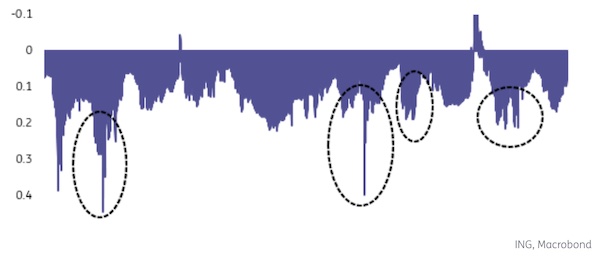
Traditionally, markets have change into exponentially delicate to the BTP-Bund unfold when it crosses the 200bp mark. That can be the brink that usually coincides with a pick-up of the correlation between Italian spreads and the euro. Within the chart under, we see how that correlation has performed out with EUR/USD – though on many events it was EUR/CHF that confirmed increased sensitivity to Italian politics, because the franc usually emerged as the popular safe-haven forex when European dangers flared up.
Why it could possibly be completely different this time
There are two arguments that recommend the euro’s sensitivity to Italian bonds could possibly be decrease this time. The primary is that the euro is already low-cost and can wrestle to cost in additional danger premium; the second is that the TPI backstop will restrict the spillover into FX.
Political dangers – identical to geopolitical dangers and energy-related shocks – affect the euro by making it commerce at decrease ranges than its typical short-term drivers (charges and equities) would recommend. In different phrases, producing a danger premium in comparison with its short-term honest worth.

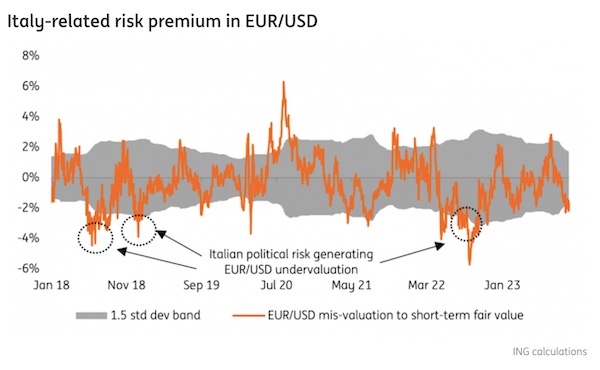
EUR/USD has suffered from intense promoting stress of late. A part of this was as a result of selloff in US bonds – which has made the USD actual price much more enticing – however our estimates present that the pair is already buying and selling at a 1.8-2.0% low cost to its honest worth. We imagine that is primarily as a result of worsening of the eurozone’s development outlook and the danger of stagflation.
On the similar time, we will word from the chart above that with out having to return to the acute occasions of 2011, the previous 5 years already noticed three situations (twice in 2018, as soon as in 2022) of Italian political danger producing a EUR/USD undervaluation bigger than 2.0%. This time, the Italian authorities will not be susceptible to dropping a majority, however the potential for rising friction with the EU following the reintroduction of fiscal guidelines might not less than see that EUR/USD danger premium being saved in place. In different phrases, if there are extra restricted draw back dangers, the room for a rebound can be fairly restricted.
With regards to TPI, the instrument has been placed on the backburner by buyers since peripheral spreads have been reasonably tight, leaving one key query for buyers: would TPI be deployed in any occasion of dangerously widening spreads (additionally if attributable to political turmoil), or provided that the bond selloff is induced by ECB tightening? The swift ECB response to Italian spreads widening in 2022 might, for now, deter extreme bearish hypothesis and restrict the spillover on the euro. Nevertheless, ought to the BTP-Bund unfold attain structurally increased ranges and Italy–EU relations deteriorate over the fiscal rule, we may see TPI conditionality changing into the centre of the dialogue in an already divided Governing Council.
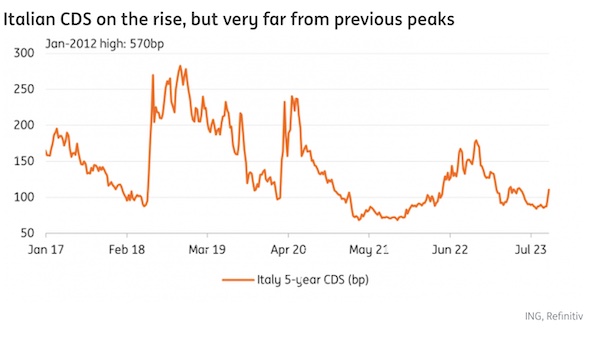
Finally, whether or not the Italian authorities might be prepared to tolerate a excessive BTP-Bund unfold to have extra fiscal room might be key – particularly if debt sustainability considerations ought to rise once more. We’ve got already noticed an increase in Italian CDS prior to now week, though nonetheless removed from the degrees seen in different political crises or throughout the Covid-19 pandemic.
Our view on the euro
EUR/USD is having fun with a reduction rally to 1.0600 on the time of writing, primarily because of USD-negative quarter-end flows. Home information and the general setting proceed to level to EUR/USD weak spot, and our charges staff sees extra upside dangers for back-end UST yields, which may pave the best way for an extra short-term depreciation in EUR/USD.
Ought to we see a cloth deterioration within the Italian bond market – and barring a swift response by the ECB to calm buyers – EUR/USD draw back dangers would prolong to the 1.00/1.02 space in an setting the place US bonds stay underneath stress on the again of stable US knowledge and the Federal Reserve stays hawkish.
The Swiss franc has usually been a beneficiary of stress within the euro space and EUR/CHF often has a detrimental correlation with significant widening within the BTP-Bund unfold. In periods of deflation, Swiss authorities would usually intervene to purchase FX and forestall the Swiss franc from appreciating an excessive amount of. Nevertheless, in in the present day’s inflationary world, the Swiss Nationwide Financial institution is now actively utilizing the Swiss franc as a financial coverage instrument and is promoting FX to handle the Swiss franc stronger. The SNB simply introduced a minimize to its steadiness sheet by CHF 40 billion within the second quarter by promoting FX – an acceleration from the 32 billion seen within the first quarter.
Presumably, if stress within the euro space created extra pure demand for the Swiss franc, the SNB would promote much less FX. But, the primary message right here is that EUR/CHF is a really managed pair, and whereas issues within the euro space stress may hasten a return to 0.9500, the SNB may simply swap again to purchasing FX to maintain EUR/CHF underneath management.
Supply: ING