


Introduction
The South China Sea, unfold over an space of three.477 million sq km, is without doubt one of the most resource-rich marine areas on the planet. It has identified reserves of 190 trillion cubic ft of pure fuel and 11 billion barrels of oil,[1] and is residence to numerous ecosystems[2] with 3,000 species of fish and 600 species of coral reef, a wide range of mangrove and seagrass species, and turtles and seabirds that use the islands for resting, breeding, and wintering. The waters are bordered by China, Vietnam, Indonesia, Malaysia, Brunei, and the Philippines.
Determine 1: South China Sea: Territorial jurisdictions and China’s 9-Sprint Line

The SCS has turn into the topic of intense discussions in recent times owing to its geopolitical and safety knots. It is without doubt one of the most disputed maritime areas on the planet, with competing territorial claims and poorly demarcated rights that give rise to additional battle amongst nations bordering the ocean. Of those nations, China is the one one which not solely claims an unlimited portion of those waters –past what’s positioned underneath its sovereignty by the UNCLOS[a] – however has additionally concerned itself in a number of actions on the varied rocks, shoals and reefs that dot these waters. These actions have provoked huge concern from the littorals and the worldwide group for his or her safety ramifications. But, one other severe impression of those actions has obtained much less consideration: the environmental injury being wrought on the native ecosystems.
Certainly, the marine ecosystem of this area was already reeling underneath the pressures of being one of many world’s busiest worldwide sea-lanes.[4] These pressures have since been compounded by the overfishing, clam extraction, dredging for development of synthetic reefs, and hydrofracking[b] being performed by China. Rising sea temperatures and sea ranges resulting from local weather change threatens to render this injury everlasting.[5]
In more moderen years, the worldwide group on a number of events has begun recognising local weather change—and its manifold impacts—as nothing lower than safety threats. The 1987 Brundtland Report,[6] the 1992 UN Convention on Surroundings and Improvement,[7] the UN Safety Council conferences in 2007,[8] 2011,[9] 2018[10] and 2019,[11] and the Paris Local weather Report have all highlighted the looming world environmental disaster.
This coverage transient makes an account of the slew of actions that China is endeavor within the South China Sea area. The transient goals to contribute to rising discussions on China’s belligerence, from a non-traditional safety viewpoint. The ensuing environmental injury from these actions could not present itself conspicuously and instantly, however early indications present that its implications on your entire area will likely be nothing lower than insidious.
To make certain, different gamers[c],[12] within the area have additionally partaken within the actions as they assert their very own claims on the disputed island territories. (Apart from the dredging actions, that are China’s sole area.) Nevertheless, there may be little doubt that China’s actions are far larger in scale and extra superior in tempo and, in accordance with varied research, have induced probably the most seen impairments.
China’s Actions within the SCS: Overview and Evaluation
Fishing
Fisheries within the South China Sea present meals and jobs to thousands and thousands of individuals inhabiting the ten littoral nations and territories.[13] A long time-long, unabated fishing has resulted in declining fish shares and given rise to one of many greatest non-traditional safety threats to the area – overfishing. This in flip threatens meals safety within the densely populated area.
For China, fisheries are essential to making sure meals safety for its burgeoning inhabitants. The wants have solely heightened with the growth of the center class who’ve important spending energy and heightened home consumption.[14] Estimates mission that by 2030, the increasing center class in China will account for 38 % of world fish consumption,[15] with home manufacturing outstripping demand.[16] Way back to in 1986, China launched a fisheries legislation with a view to increasing the nation’s fishing actions. By 2018, in accordance with the 2020 Meals and Agriculture Group’s Yearbook of Fishery and Aquaculture Statistics,[17] China accounted for 15 % of the full world catch. This translated to 62.2 MMT a yr, together with 47.6 MMT of aquaculture manufacturing and 14.6 MMT of seize manufacturing. Additionally it is the world’s greatest exporter of fisheries, with exports amounting to 21.6 MMT in 2018. The fishery business in China employs 14 million folks.[18]

The overfishing—and unlawful and unregulated fishing—has resulted within the speedy depletion of fish shares in China’s coastal areas. The nation has misplaced[20] half of the coastal wetlands, 57 % of mangroves and 80 % of coral reefs in its personal Unique Financial Zone (EEZ)—these are vital for the spawning, nursing and feeding of the fish shares. In an effort to maintain their fisheries demand, China has expanded its fishing fleets, sending them so far as Africa and South America. Chinese language fleets have been caught trawling within the EEZs of nations akin to Argentina, Somalia and South Korea.[21] Within the South China Sea, which accounts for 16.6 MMT of catch per yr, fishing shares have plunged by a 3rd over the previous 30 years; it’s estimated that the shares will fall additional by 59 % by 2045.[22]
It’s not solely China’s fishing shares which have declined because of the nation’s fishing actions; these of different nations[23] have dwindled as properly. Many small Chinese language vessel homeowners are paid or given gas subsidies to fish within the EEZs of different nations. In keeping with the submissions[24] to the Everlasting Courtroom of Arbitration (PCA) by the Philippines within the historic case, Philippines v. China, Chinese language fishermen have illegally harvested corals, marine turtles, clams, sharks, eels and different marine animals from the waters of different nations on a number of events.
As fish shares close to coastal areas scale back and the Catch Per Unit Effort (CPUE) sharply decline[25] over time, fishermen are transferring out farther and deeper into the ocean and utilising strategies akin to cyanide[d] and dynamite fishing,[e],[26] which in flip are inflicting additional injury to marine life. Strategies akin to blasting utilizing dynamite and cyanide poisoning kill or impair scores of fish at one go, in order to extend the amount of every catch. Dynamite blasts not solely kill their topics but additionally destroy the coral reefs that function breeding grounds for shares and are integral in sustaining carbon-dioxide ranges within the ocean. Cyanide, in the meantime, accelerates the bleaching of coral reefs and typically outrightly kills them. These strategies are additionally used at larger depths, thereby impacting the seabed as properly.
Determine 2: Depletion in fish shares within the South China Sea
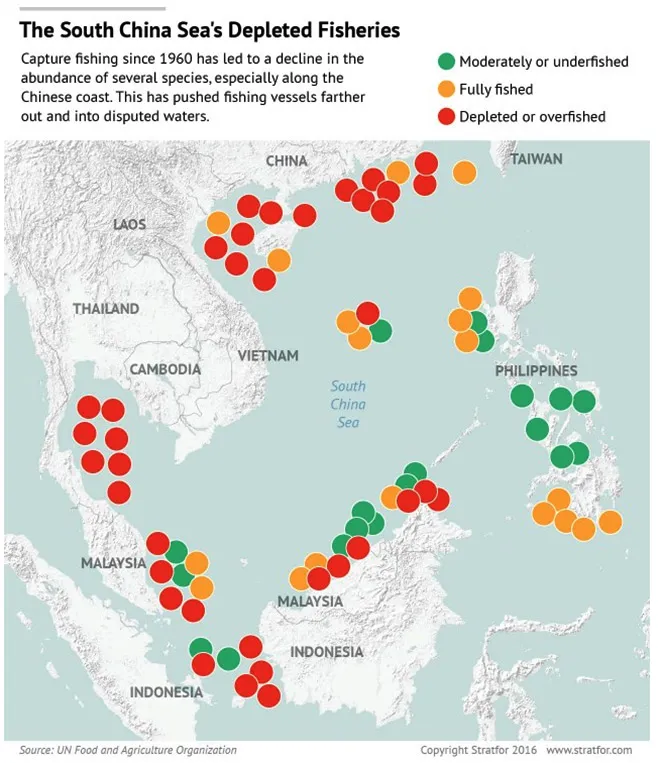
The skilled report submitted by the Philippines to the PCA has additionally analysed the impacts of the Chinese language development actions and overfishing on the fishing shares of the area. In keeping with a examine[28] quoted by the Philippines’ report, the Spratly Islands[f] are an vital supply of fish larvae that get transported to different areas as properly. For instance, this examine suggests, wholesome marine wildlife populations on the Spratly Islands may have useful results in serving to maintain fisheries within the western Philippines. Conversely, the overexploitation of fisheries assets on the Spratly Islands could have a damaging impression on fish shares and fisheries within the Philippines. One other examine[29] cited within the Philippines’ report discovered that since a lot of the reefs constructed by China within the Spratlys are within the western half and are diametrically removed from the stock-rich area within the east of the islands, any lack of fisheries within the Spratlys wouldn’t be recoverable rapidly.
Each of those research reveal the existence of some larval alternate among the many Spratly Islands, Scarborough Shoals, Paracel Islands, and reefs of the primary Philippine islands. Such connectivity likely has evolutionary significance in sustaining the biodiversity of the Spratly Islands. This regional position of the islands, as a supply of fisheries replenishment, may simply be diminished by means of the lack of habitat high quality and worsening of native fisheries exploitation due to the development of everlasting dwellings. Subject-verified fashions have established {that a} lack of reef habitat reduces the productiveness of the fishery threefold. Due to this fact, the constructions will enormously compromise the reefs’ capability not solely to maintain native fisheries, but additionally to assist replenish the fisheries of neighbouring seas.


A examine performed by the Centre for Strategic and Worldwide Research (CSIS)[32] reveals the intensive fishing exercise within the SCS. The 2 photos in Figures 3 and 4 present[g] the rise in night-time fishing exercise within the SCS between January 2013 and Might 2018. The identical examine revealed the huge distinction between the fishing vessels reportedly out at sea, and the precise variety of vessels which might be traversing the waters: most vessels both intentionally escape detection, or information can’t be collected as a result of the boats are usually not trendy sufficient. A larger focus of fishing vessels can be close to Chinese language outposts, particularly near the Subi and Mischief Reefs.
Determine 3: Brilliant lights reveal fishing exercise within the SCS at evening in January 2013

Determine 4: Brilliant lights reveal fishing exercise within the SCS at evening in Might 2018

The monitoring information reveals that many of those vessels are usually not engaged in fishing in any respect, regardless of being massive trendy trawlers. Fairly, the indicators point out that they continue to be stationed for extended durations in particular elements of the waters – particularly across the Spratly islands. As many Chinese language fishing vessels additionally double because the nation’s maritime militia, their mere presence can escalate the tenuous state of affairs with the very actual risk of clashes with fishing vessels of different nations.[35] China’s maritime militia provides to the armed forces personnel deployed by the completely different littorals—compounding the securitisation of the ocean house. These fishing vessels are additionally dubbed “darkish fishing fleets”[36] and are engaged in “unseen”[37] fishing actions –in different phrases, they’re engaged in patrolling, resupply and surveillance operations within the space.
Dredging and Development
Since 1947, China has laid a “historic” declare over a lot of the South China Sea. Chinese language nationwide maps replicate this whole space to be inside the bounds of the U-shaped “nine-dash line”[38] that runs alongside the coasts of Taiwan, the Philippines, Malaysia, Brunei, Indonesia and Vietnam. In 1974, it drove out Vietnamese troops and laid declare to many islands and rocks within the area. Because the Nineteen Eighties, it has chased out the fishing troops of different nations and brought over many reefs. Starting in 2015, it has aggressively reclaimed land in these islands and reefs both by growing their dimension or creating new ones, such because the Subi Reef on the Spratly Islands. It has constructed ports, army installations, and airstrips—notably within the Paracel and Spratly Islands,[39] the place it has, respectively, 20 and 7 outposts. It has deployed fighter jets, cruise missiles, and a radar system on the Woody Island within the Paracels.
Dredging on these islands—carried out as preparation for constructions—has been discovered to be primarily accountable for the destruction of reef flats.[40] Dredgers sweep in a back-and-forth movement, slicing by means of all types of fabric, onerous rocks to gentle sediments, and thus destroying life alongside its path.[h]
China claims that it’s dredging solely in shallow waters—and subsequently not posing important hazard. Nevertheless, marine scientists, utilizing satellite tv for pc imagery, have discovered that China is certainly finishing up dredging actions within the deep waters as properly.[41] The dredging actions have been discovered to ship up plumes of sediment and corrosive sand,[42] laced with metallic and oil from the dredging ships, which is seen as darkish blue clouds on satellite tv for pc imagery. These plumes wash again into the ocean and smother[43] the species underwater by blocking daylight and oxygen. Elevated sedimentation within the water columns of those reefs has additionally decreased the absorption and chlorophyll within the area, which is crucial for the survival of phytoplankton and which in flip present meals for a variety of marine life.
Alteration of the coral reefs has additionally disrupted the dynamics of resuspension and deposit of sediments on the seafloor. The periodic dredging to clear built-up sediments will forestall most reef organisms from settling, and can seemingly create a power drawback of sand and silt plumes for surrounding marine ecological zones. These actions have led to elevated turbidity[44],[i] and sedimentation on the lagoons surrounding these reefs. This has induced reside coral reef species to be buried and killed underneath the reef flats because of the development actions. As soon as a coral reef has been buried underneath tonnes of sand and gravel, it’s just about useless.[45] Deep dredging cuts by means of 1000’s of years of reef limestone and these sediments are notably hazardous to gentle and onerous corals.[46] They’ll scale back development charges, trigger lesions, and inhibit sexual replica amongst species. The weakened corals could turn into prone to ailments. In keeping with the skilled report[47] submitted to the PCA within the case of Philippines v. China, 27 % of the shallow reef space of the seven reefs within the South China Sea have been completely misplaced (i.e., buried or excavated past visibility from the floor). Channel dredging has affected 1.4 sq km of reef on the seven reefs thought of on this transient, whereas the quantity of shallow reef space affected by dredging for the gathering of fill supplies is 39.3 sq km.
Elevated sediment ranges have additionally affected the survival of the fish shares within the area. It is because the plumes and sediment clouds that rise from dredging operations inhibit[48] the visible and chemical cues of the fishes, making them much less able to find their foraging spots and habitat, in addition to figuring out predators and prey. Within the Nice Barrier Reef in Australia, for instance, clownfish pods developed mucous of their gills and pathogenic micro organism resulting from extended publicity[49] to such sediments.
Added to this injury attributable to construction-related dredging actions are an estimated 68.8 sq km of shallow reef injury believed to be attributable to clam excavation that makes use of boat propellers.[j] In keeping with satellite tv for pc imagery, a lot of the injury has been made (and sediment stirred up) by quite a few small Chinese language propeller boats which were used to extract large clams[50] from the shallow waters surrounding the reefs. Though fishers from the Philippines and Vietnam additionally harvest wild large clams, solely fishers from China have been identified to make use of the strategy of digging up the underside of the ocean with boat propellers.
Hydrofracking
Starting within the Nineteen Eighties, China carried out seismic surveys[51] within the South China Sea area and estimated that the Spratly Islands held deposits of 25 billion cubic meters of pure fuel and 105 billion barrels of oil. A few years later, in 2003, China revised its estimates of pure fuel reserves within the area to 980 billion cubic meters. Different research have reckoned the presence of about 40 billion tonnes of fuel hydrate reserves[52] at 11 hotspots throughout the South China Sea.
Certainly, China has carried out oil and fuel exploration actions within the area for the reason that Nineties. In 1992, it signed a contract with Crestone Vitality Company, owned by the Houston-based Pure Assets Inc.,[53] to conduct oil exploration actions on the Vanguard Financial institution within the Spratly Islands, which Vietnam claimed to be in its continental shelf. In 1994, Crestone, together with the China Nationwide Offshore Oil Company (CNOOC) commenced exploration actions within the Wan-an-bei-21 (WAB-21 block) within the Spratly Islands. In 1997, the Chinese language Kantan-3 oil rig drilled within the Da Nang space close to the Spratlys, which Vietnam claims as Block 113. CNOOC has additionally collaborated with different corporations akin to Devon Vitality Company, based mostly in Oklahoma, US.[54] and Husky Oil China Restricted[55] to hold out drilling operations within the space. In keeping with official figures printed by CNOOC[56] in 2019, it was producing 286,790 barrels/day of crude oil and 709.1 mmcf/day of pure fuel from their oil fields within the Western and Jap South China Sea areas. Beijing has additionally positioned a 10-storey oil drilling platform[57] within the space disputed with Vietnam, which may dig as much as a depth of 9,000 meters.
Offshore oil and fuel operations pose important environmental hazard[58] since these actions launch enormous quantities of liquids, solids and fuel into the waters, damaging the ecosystems and endangering the species that inhabit them. The preliminary seismic surveys, the rig set up and drilling, the hydrocarbon manufacturing, and the transportation of the oil and pure fuel trigger injury to the seabed. From drilling to restoration of the oil, the impacts on the marine surroundings range throughout the levels. Huge tasks that dig deeper for extraction are extra impactful. Seismic surveys trigger noise, emissions and discharges that hurt the fish pods which might be depending on auditory and visible cues as they traverse their habitat. Drilling operations dispose slurry consisting of mud, cuttings, wash water, drainage, and sewage into the ocean. Additionally they trigger dangerous emissions with frequent leakage and spillage of the extracted hydrocarbons.
Implications of China’s Actions
Desk 2 confirmed that Chinese language fleets within the South China Sea are way over these deployed by different littoral States within the area. Equally, Desk 3 confirmed that China’s complete fish seize from the SCS far exceeds that of its subsequent competitor within the area, Malaysia. China’s overzealous fishing actions within the area have put the fisheries in near-collapse. Its encroachment upon the EEZs (which had been designed to safeguard[59] meals safety since a lot of the fish shares are inside 200 miles of a shore) of different nations within the area and driving out their fishing vessels from their very own waters, threatens to jeopardise the sourcing of a staple meals of huge populations within the area. The South China Sea can be vital for world fish demand because it provides 12 % of the worldwide fish catch. Nevertheless, over the previous twenty years, fish shares have fallen by 66-75 %.[60] As mentioned earlier on this transient, the power of fishery shares to replenish has been severely hampered by China’s dredging and development actions.
Over the previous few many years, local weather change and rising sea temperatures have turn into a major risk to world fisheries. It has induced sea temperatures to rise and oceans to turn into acidic, and has altered the oxygen and carbon focus within the waters, making the sustenance of marine life tough. The South China Sea is amongst considered one of three “epicentres”[61] which were touted to be severely impacted by this phenomenon.[k] Rising ocean-surface temperatures have the potential to pressure fish shares emigrate farther north in direction of East China Sea and Sea of Japan. This can make fishing more durable for nations like Vietnam, Malaysia, Indonesia, and the Philippines, which lack the assets to fish in distant waters.
China’s heavy-handed method on this area has additionally put the vitality safety of its neighbours in jeopardy, with the Philippines and Vietnam being the worst hit. Virtually half of the Philippines’ vitality combine is produced on the Malampaya fuel subject in Luzon Islands, which is predicted to start out operating dry by 2024.[62] Although the Reed Financial institution stays its absolute best different, getting ready a brand new fuel subject takes at the very least 10 years. With China unrelenting in its claims over Reed Financial institution, this different appears equally bleak. In the meantime, Vietnam’s potential to draw international investments has suffered after it was compelled to finish its take care of Repsol (a Spanish vitality and petrochemical firm based mostly in Madrid) amidst stress from China. It may additionally should pay damages to the corporate which had invested an estimated $200 million for offshore fuel drilling. Petro Vietnam, Vietnam’s state-owned vitality firm, has admitted that its crude oil manufacturing will fall by 10 % per yr as much as 2025 resulting from its incapacity to discover new fuel reserves.[63]
Contravention of Worldwide Regulation
Within the worldwide legislation regime, there are broadly two methods by means of which a State upholds its worldwide authorized obligations: by itself volition, or it’s coerced by different highly effective States. China’s case is confounding because it walks neither of those paths. That China stays unfazed amidst allegations of violating provisions of worldwide legislation[64] is greatest exemplified by its refusal to honour the choice of the PCA within the case filed towards it by the Philippines. Lack of policing and implementation mechanisms with worldwide multilateral organisations leaves the compliance of their orders on the discretion of States. China’s rising financial and army would possibly make it tough for different world powers to problem it efficiently.
China’s actions within the South China Sea quantity to a flagrant violation of worldwide legislation and environmental treaties. The UNCLOS,[65] which China has ratified, mandates that the “states have the duty to guard and protect the marine surroundings.” Article 194 of the Conference imposes an obligation upon Member-States to “be sure that actions underneath their jurisdiction or management are so performed as to not trigger injury by air pollution to different States and their surroundings.” Additionally they have the accountability to guard the “uncommon or fragile ecosystems” with a view to shield the endangered marine species. China has additionally ratified the Conference on Organic Range[66] which mandates the member states to make sure that their actions don’t trigger environmental injury past their nationwide jurisdiction.
China can be social gathering to the Conference on the Prevention of Marine Air pollution by Dumping of Wastes and Different Matter 1972,[67] which stipulates reporting necessities and adherence to compliance procedures from its Events. It has additionally acceded to the Worldwide Conference for the Management and Administration of Ships’ Ballast Water and Sediments, 2004.[68] China claims that it has carried out its island constructing actions with full regard of “science-based analysis”[69] and has adopted all of the worldwide environmental safety requirements to make sure ecological and fishery preservation. Nevertheless, the Chinese language authorities has[70] supplied neither enough proof to again these claims, nor any evaluation studies to worldwide organisations.
Maybe probably the most scathing criticism of China’s island-building actions from the standpoint of worldwide legislation was contained within the PCA’s choice within the Philippines v. China.[71] The Philippines claimed that China was interfering with its fishing rights across the Scarborough Shoal and in its EEZ. It additionally demanded a willpower on the usage of the ‘nine-dash line’ as a way of maritime delimitation over the principles set underneath the UNCLOS. Asserting the award in favour of the Philippines, the PCA made pertinent observations with respect to the impression of Chinese language actions on the ecosystem of the South China Sea. The PCA famous that the “nine-dash” line had no foundation in legislation and subsequently, China doesn’t have sovereignty over areas past its personal EEZ. It held China’s island-building actions and fishing actions to be violative of the Philippines’ rights over its personal EEZ. It held that these actions had been accountable for substantive coral reef injury, depletion of endangered species, plunge in fishing shares, and disturbance to the structural integrity of the islands and reefs within the area. It criticised the usage of cyanide and dynamite by the Chinese language trawlers and acknowledged its dangerous results on the oceanic biosystems. It famous that regardless of diplomatic communications and several other warning, China willingly continued its unlawful actions.
The PCA held China to be in violation of Articles 192, 194 (1) and 194 (5) of the Conference which obligated them to protect and shield the marine surroundings. It was additionally held to have violated Article 197 and 123 of the Conference which requires the States, particularly these surrounding a closed or semi-enclosed space, to cooperate on a regional foundation with a view to formulate commonplace practices and protocols for a similar. Article 206 of the Conference too was held to be violative, which requires States to evaluate the potential results of their actions on the marine surroundings if it has motive to imagine that such actions will trigger “important and dangerous change” to the identical. It famous that on the scale of China’s constructions, there is no such thing as a motive to imagine that it might have been unaware of the results of such operations. Beneath the aegis of this provision, China was obligated to offer an Environmental Affect Evaluation (EIA) Report of its actions to the Worldwide Maritime Group; Beijing refrained. It’s estimated that even when the island constructing mission is scrapped, it might take many years for the surroundings to get well.[72]
Additionally, China has come to seize[73] the highest jobs in key worldwide our bodies and has turn into the second largest contributor to the UN by offering for 12 % of its common price range. Due to this fact, multilateral boards, which may have at the very least condemned China’s actions, have averted doing so. That is greatest typified by the World Well being Group’s (WHO) silence[74] about criticisms that China failed to tell the worldwide group early sufficient in regards to the preliminary outbreak of the novel coronavirus.
Conclusion
Many Southeast Asian nations have established regional our bodies for managing the fisheries within the South China Sea area. These our bodies, notably, embody the Asia-Pacific Fishery Fee (APFIC), the Southeast Asian Fisheries Improvement Heart (SEAFDEC), and the Regional Plan of Motion to Promote Accountable Fishing Practices (RPOA). Nevertheless, most of those entities play solely an advisory position in policymaking or just perform evaluation and analysis associated to fishery administration. Many of the agreements that supplied for the establishing of those organisations are worded in non-binding language. They require merely voluntary implementation of the suggestions and go away the execution on co-management and cooperation, which is essentially absent. One such working group launched by the US Heart for Strategic and Worldwide Research and comprising marine biologists, coverage strategists and professionals of maritime legislation, proposed a blueprint for environmental cooperation within the SCS and recognized areas of accountability for the administration of fisheries with the zones ideated by this blueprint given in Determine 5.
Determine 5: Fishery and Environmental Administration Zones within the South China Sea

China has refused to take part in these efforts, making the way forward for cooperation bleak. The proposed ASEAN-China Code of Conduct (COC),[76] issued in 2002 and meant to control conduct of the events within the South China Sea, is seen as a step within the optimistic route. Nevertheless, it has thus far not produced a ultimate settlement primarily resulting from lack of consensus amongst the events though ASEAN and China hope to finalise it in 2021.
Concerning the Authors
Pratnashree Basu is Affiliate Fellow at ORF Kolkata. Aadya Chaturvedi is a 4th yr legislation pupil on the West Bengal Nationwide College of Juridical Sciences.
Endnotes:
[a] The United Nations Conference on the Regulation of the Seas (UNCLOS) additionally known as Regulation of the Sea Conference or the Regulation of the Sea treaty, got here into impact in 1982. It’s the authorized framework delineating the geographic jurisdictions of coastal states and defining rights and obligations governing marine and maritime exploitation and conservation.
[b] Hydrofracking or fracking, is a way for oil and fuel extraction from areas with fossil vitality deposits which might be inaccessible to drilling. Unregulated fracking is detrimental to the standard of air and floor and floor water, in addition to dangerous for marine and wildlife.
[c] Vietnam, the Philippines, Malaysia and Taiwan have bolstered land options within the South China Sea.
[d] In cyanide fishing, fish are surprised by squirting them with poison. The reside fish are then caught and find yourself in costly reside seafood eating places and inns.
[e] In dynamite fishing, dozens of fish are killed without delay with selfmade underwater bombs.
[f] The Spratly islands situated within the South China Sea are an archipelago comprising islands, islets, reefs and submerged atolls that are claimed in complete or half by China, Taiwan, Malaysia, the Philippines, Vietnam, and Brunei.
[g] The examine utilised information from Seen Infrared Imaging Radiometer Suite (VIIRS) Boat Detection, which detects shiny gentle sources at sea to pinpoint fishing actions; and Artificial Aperture Radar (SAR) which offers the approximate vessel rely at any given time and site.
[h] Coral reefs are an vital breeding floor for marine species and are accountable for defending the coasts. They’re the point of interest of marine life and their loss of life causes your entire ecosystem to unravel.
[i] The extent of transparency of water; used as a primary measure to verify for the obvious air pollution of a water physique
[j] These clams are used for industrial merchandise akin to ornamental shells.
[k] The opposite two epicentres are the Artic and the African great-lakes.
[1] “South China Sea Energy Exploration and Development”, Asia Maritime Transparency Initiative.
[2] Chloe Houdre, “Environmental Ramifications of the South China Sea Conflict: Vying for Regional Dominance at the Environment’s Expense”, Georgetown Environmental Regulation Overview, 12 July 2018.
[3] Robert Manning and Patrick M. Cronin, “Under Cover of Pandemic, China Steps Up Brinkmanship in South China Sea”, International Coverage, 14 Might 2020.
[4] “How Much Trade Transits the South China Sea?”, China Energy, CSIS.
[5] Wilson VornDick, “Thanks Climate Change: Sea-Level Rise Could End South China Sea Spat” The Diplomat, 8 November 2012.
[6] “Report of the World Commission on Environment and Development: Our Common Future”.
[7] “United Nations Conference on Environment and Development (UNCED), Earth Summit”.
[8] “Security Council Holds First-Ever Debate on Impact of Climate Change on Peace, Security, Hearing over 50 Speakers”, UN, 17 April 2007.
[9] UNSC 6587th Meeting, 20 July 2011.
[10] UNSC 8307th Meeting, 11 July 2018.
[11] Letter dated 4 February 2019 from the Chargé d’affaires a.i. of the Permanent Mission of the Dominican Republic to the United Nations addressed to the Secretary-General, UNSC, 7 February 2019.
[12] Dolven, et. Al, “Chinese Land Reclamation in the South China Sea: Implications and Policy Options”, US Congressional Analysis Service Report, 18 June 2015.
[13] Rachel Bale, “One of the World’s Biggest Fisheries Is on the Verge of Collapse”, Nationwide Geographic, 29 August 2016.
[14] Dominic Barton, “The Rise of the Middle Class in China and Its Impact on the Chinese and World Economies”, in US-China Financial Relations within the Subsequent 10 years, China-US Focus.
[15] “Fish to 2030: Prospects for Fisheries and Aquaculture”, World Bank, 2013.
[16] Beatrice Crona, et. al, “China at a Crossroads: An Analysis of China’s Changing Seafood Production and Consumption”, One Earth, Quantity 3, Concern 1, 24 July 2020.
[17] “Fishery and Aquaculture Statistics”, Meals and Agriculture Organisation of the UN, 2020.
[18] Employment Statistics, OECD.
[19] Compiled utilizing information from Fishery and Aquaculture Statistics, Annual Report, FAO, 2018
[20] Ling Cao, et, al., “Opportunity for marine fisheries reform in China”, ONAS, 17 January 2017.
[21] Matthew Sedacca, “China has fished itself out of its own waters, so Chinese fishermen are now sticking their rods in other nations’ seas”, Quartz, 4 April 2017.
[22] Michael Perry, “Maritime Law Enforcement and Overfishing in the South China Sea”, The Maritime Govt, 4 October 2020.
[23] Perry, “Maritime Regulation Enforcement and Overfishing within the South China Sea”, a
[24] Arbitration under Annex VII of the United Nations Convention on the Law of the Sea, 30 March 2014.
[25] Adam Greer, “The South China Sea Is Really a Fishery Dispute”, The Diplomat, 20 July 2016.
[26] Ralph Jennings, “Overfishing Continues to Harm Sea Life in South China Sea”, VOA, 14 Might 2020.
[27] Rodger Baker et. al., “Fish: The Overlooked Destabilizer in the South China Sea”, Stratfor, 12 February 2016.
[28] Patrick R. Pata and Aletta T. Yñiguez, “Larval connectivity patterns of the North Indo-West Pacific coral reefs”, PLoS ONE, Quantity 14, Concern 723 July 2019.
[29] Jeffry G. Dorman, “Modeled connectivity of Acropora millepora populations from reefs of the Spratly Islands and the greater South China Sea”, Coral Reefs, Vol. 35, 25 September 2015.
[30] Compiled utilizing information from Fishery and Aquaculture Statistics, Annual Report, FAO, 2018
[31] Compiled utilizing information from Fishery and Aquaculture Statistics, Annual Report, FAO, 2018
[32] Gregory B. Poling, “Illuminating the South China Sea’s Dark Fishing Fleets”, CSIS, 9 January 2019.
[33] Poling, “Illuminating the South China Sea’s Darkish Fishing Fleets”
[34] Poling, “Illuminating the South China Sea’s Darkish Fishing Fleets”
[35] Poling, “Illuminating the South China Sea’s Darkish Fishing Fleets”
[36] Zhang Hongzhou, “Beijing has a maritime militia in the South China Sea. Sound fishy?”, South China Morning Submit, 3 March 2019.
[37] Gregory B. Poling, “Illuminating the South China Sea’s Dark Fishing Fleets”, CSIS, 9 January 2019.
[38] Liu Zhen, “What’s China’s ‘nine-dash line’ and why has it created so much tension in the South China Sea?” South China Morning Submit, 12 July 2016.
[39] China Island Tracker, Asia Maritime Transparency Initiative.
[40] “What is China’s ‘magic island-making’ ship?”, BBC, 6 November 2017.
[41] Ke-Fu Yu, et. al., “Storm cycles within the final millennium recorded in Yongshu Reef, southern South China Sea”, Palaeogeography, Palaeoclimatology, Palaeoecology, Quantity 210, Concern 1, 23 July 2004, Pages 89-100
[42] Johnny Langenheim, “Preventing Ecocide in South China Sea”, The Guardian, 15 July 2015.
[43] Leland Smith et. al., “Evidence of Environmental Changes Caused by Chinese Island-Building”, Scientific Studies, Article no. 5295, 28 March 2019.
[44] Paul L.A. Erftemeijer and Roy R. Robin Lewis, Environmental impacts of dredging on seagrasses: A review, Marine Pollution Bulletin, Quantity 52, Concern 12, 2006.
[45] John W. McManus, “Offshore Coral Reef Damage, Overfishing, and Paths to Peace in the South China Sea”, The Worldwide Journal of Marine and Coastal Regulation, Vol. 32, Concern, 2, 2017.
[46] John W. McManus, “Offshore Coral Reef Damage, Overfishing, and Paths to Peace in the South China Sea”, The Worldwide Journal of Marine and Coastal Regulation, Vol. 32, Concern, 2, 2017.
[47] Sebastian C.A. Ferse and Selina Ward, “Assessment of the potential environmental consequences of construction activities on seven reefs in the Spratly Islands in the South China Sea”, Everlasting Courtroom of Arbitration, 14 October 2015.
[48] A.S Wenger, et. al., “Suspended sediment alters predator–prey interactions between two coral reef fishes”, Coral Reefs, Vol. 32, June 2013, https://hyperlink.springer.com/article/10.1007/s00338-012-0991-z#citeas
[49] Sybille Hess, et. al., “Publicity of clownfish larvae to suspended sediment ranges discovered on the Nice Barrier Reef: Impacts on gill construction and microbiome”, Scientific Studies, June 2015, https://pubmed.ncbi.nlm.nih.gov/26094624/
[50] Victor Robert Lee, “Satellite tv for pc Imagery Reveals Ecocide within the South China Sea”, The Diplomat, 15 January 2016, https://thediplomat.com/2016/01/satellite-images-show-ecocide-in-the-south-china-sea/
[51] John W. Garver, “China’s Push By means of the South China Sea: The Interplay of Bureaucratic and Nationwide Pursuits”, The China Quarterly, 12 February 2009, https://www.cambridge.org/core/journals/china-quarterly/article/abs/chinas-push-through-the-south-china-sea-the-interaction-of-bureaucratic-and-national-interests/A3E17E30FF3AE1F37000B904F1E2CB62
[52] Nguyen Nhu Trung, “The fuel hydrate potential within the South China Sea”, Journal of Petroleum Science and Engineering, Volumes 88–89, 2012, Pages 41-47, https://doi.org/10.1016/j.petrol.2012.01.007
[53] “Accord seen doable off China, Viet Nam”, Oil and Gasoline Journal, https://www.ogj.com/residence/article/17234573/accord-seen-possible-off-china-viet-nam
[54] “Devon, CNOOC signal deepwater production-sharing contracts”, Oil and Gasoline Journal, 12 December 2006, https://www.ogj.com/exploration-development/article/17281056/devon-cnooc-sign-deepwater-productionsharing-contracts
[55] “Husky, CNOOC signal South China Sea exploration settlement”, Oil and Gasoline Journal, 17 August 2004, https://www.ogj.com/exploration-development/article/17291110/husky-cnooc-sign-south-china-sea-exploration-agreement
[56] CNOOC Annual Report, 2019, https://www.cnoocltd.com/connect/0/f6a7aa6b93294582889a1b0aec07c8f1.pdf
[57] Ralph Jennings, “Beijing Preps 10-Story Oil Drilling Platform for South China Sea regardless of Cautious Vietnam”, VOA, 30 September 2019, https://www.voanews.com/east-asia-pacific/beijing-preps-10-story-oil-drilling-platform-south-china-sea-despite-wary-vietnam
[58] Yann-Huei Tune, “The Potential Marine Air pollution Menace from Oil and Gasoline Improvement Actions within the Disputed South China Sea/Spratly Space: A Function that Taiwan Can Play”, Ocean Improvement & Worldwide Regulation, 39:2, 2008, https://doi.org/10.1080/00908320802013768
[59] James Kraska, “The Misplaced Dimension: Meals Safety and the South China Sea Disputes”, Nationwide Safety Journal, Harvard Regulation College, 26 February 2015, https://harvardnsj.org/2015/02/the-lost-dimension-food-security-and-the-south-china-sea-disputes/
[60] Poling, “Illuminating the South China Sea’s Darkish Fishing Fleets”
[61] Caitlin E. Werrell and Francesco Femia, “Epicenters of Local weather and Safety: The New Geostrategic Panorama of the Anthropocene”, The Centre for Local weather and Safety, June 2017, https://climateandsecurity.org/wp-content/uploads/2017/06/10_fish-conflict.pdf
[62] Felix Okay. Chang, “Operating Out of Gasoline: Philippine Vitality Safety and the South China Sea, International Coverage Analysis Institute, 6 September 2019, https://www.fpri.org/article/2019/09/running-out-of-gas-philippine-energy-security-and-the-south-china-sea/#:~:textual content=Runningpercent20Outpercent20ofpercent20Gaspercent3Apercent20Philippinepercent20Energypercent20Securitypercent20andpercent20thepercent20Southpercent20Chinapercent20Sea,-Felixpercent20K.&textual content=Aboutpercent2080percent20kmpercent20offpercent20the,mainpercent20domesticpercent20sourcepercent20ofpercent20energy.&textual content=Butpercent20bypercent20thepercent20midpercent2Dto,ispercent20expectedpercent20topercent20runpercent20dry.
[63] “Vietnam crude oil output to fall 10% a yr by means of 2025: PetroVietnam”, Vitality World, The Financial Occasions, 24 October 2018, https://vitality.economictimes.indiatimes.com/information/oil-and-gas/vietnam-crude-oil-output-to-fall-10-a-year-through-2025-petrovietnam/66344718
[64] “Beijing rejects tribunal’s ruling in South China Sea case”, The Guardian, 12 July 2016, https://www.theguardian.com/world/2016/jul/12/philippines-wins-south-china-sea-case-against-china
[65] United Nations Conference on the Regulation of the Sea, https://www.un.org/depts/los/convention_agreements/texts/unclos/unclos_e.pdf
[66] Conference on Organic Range, United Nations, 1992, https://www.cbd.int/doc/authorized/cbd-en.pdf
[67] 1996 Protocol to the Conference on the Prevention of Marine Air pollution by Dumping of Wastes and Different Matter, 1972 (as amended in 2006), https://wwwcdn.imo.org/localresources/en/OurWork/Surroundings/Paperwork/PROTOCOLAmended2006.pdf
[68] Worldwide Conference for the Management and Administration of Ships’ Ballast Water and Sediments, 2004, Worldwide Maritime Organisation, http://library.arcticportal.org/1913/1/Internationalpercent20Conventionpercent20forpercent20thepercent20Controlpercent20andpercent20Managementpercent20ofpercent20Shipspercent27percent20Ballastpercent20Waterpercent20andpercent20Sediments.pdf
[69] An Interview on China’s Development Actions on the Nansha Islands and Reefs, Ministry of International Affairs of the Peoples’ Republic of China, 27 Might 2015, https://www.fmprc.gov.cn/mfa_eng/zxxx_662805/t1267264.shtml
[70] Matthew Southerland, “China’s Island Constructing within the South China Sea: Harm to the Marine Surroundings, Implications, and Worldwide Regulation”, US-China Financial and Safety Overview Fee, 12 April 2016, https://www.uscc.gov/websites/default/recordsdata/Analysis/China’spercent20Islandpercent20Buildingpercent20inpercent20thepercent20Southpercent20Chinapercent20Sea_0.pdf
[71] The South China Sea Arbitration Award of 12 July 2016, https://pcacases.com/net/sendAttach/2086
[72] Jackie Northam, “One Outcome Of China’s Buildup In South China Sea: Environmental Havoc”, NPR, 2 September 2016, https://www.npr.org/sections/parallels/2016/09/01/491395715/one-result-of-chinas-buildup-in-south-china-sea-environmental-havoc#:~:textual content=Onepercent20Resultpercent20Ofpercent20China’spercent20Builduppercent20Inpercent20Southpercent20Chinapercent20Seapercent3Apercent20Environmentalpercent20Havoc,-ListenpercentC2percentB7percent204percent3A23&textual content=Universitypercent20ofpercent20Miami-,Coralpercent20rubblepercent20remainspercent20afterpercent20percent22chopperpercent22percent20boatspercent20killedpercent20branchingpercent20coralspercent2C,stormpercent20wavespercent20ofpercent20blastpercent20fishing
[73] Tung Cheng-Chia and Alan H. Yang, “How China Is Remaking the UN In Its Personal Picture” The Diplomat, 9 April 2020, https://thediplomat.com/2020/04/how-china-is-remaking-the-un-in-its-own-image/
[74] Srinivas Mazumdaru, “What affect does China have over the WHO?”, DW, 17 April 2020, https://www.dw.com/en/what-influence-does-china-have-over-the-who/a-53161220
[75] “A Blueprint for Fisheries Administration and Environmental Cooperation within the South China Sea” Asia Maritime Transparency Initiative, 13 September 2017, https://amti.csis.org/coc-blueprint-fisheries-environment/
[76] Nguyen Minh Quang, “Saving the China-ASEAN South China Sea Code of Conduct”, The Diplomat, 29 June 2019, https://thediplomat.com/2019/06/saving-the-china-asean-south-china-sea-code-of-conduct/
[77] Pratnashree Basu, “Excessive Tide within the South China Sea: Why the Maritime Guidelines-Primarily based Order is Consequential”, ORF Concern Temporary No. 325, November 2019, Observer Analysis Basis