Their rising bonhomie however, India and the US should not ready to change their respective interpretations of the United Nations Conference on Legal guidelines of Sea (UNCLOS) with regard to the rights and obligations of the international ‘Maritime States’ within the Unique Financial Zone (EEZ) of 200 nautical miles (370 kilometers) of the ‘Coastal States’.
These variations have been mirrored as soon as once more with the American Warship USS John Paul, belonging to US Seventh Fleet, conducting “navy maneuvers” as “freedom of navigation operations” close to Lakshadweep, very a lot in India’s EEZ, earlier this week, with out the consent of New Delhi.
An announcement of India’s Ministry of Exterior Affairs says that “We now have conveyed our issues concerning this passage by way of our EEZ to the Authorities of U.S.A by way of diplomatic channels”. However US Navy is non-repentant.
It has claimed that “India’s requirement of prior consent is inconsistent with worldwide legal guidelines the liberty of navigation operations (FONOPs) was meant to problem its extreme maritime claims”.
It’s to be famous that this isn’t the primary time that the 2 nations have clashed over their claimed rights. That they had completed so in March 2001. At the moment the UK, just like the US, was additionally doing one thing comparable elsewhere in India’s EEZ, a lot to the displeasure of New Delhi.
The then-Indian Protection Minister George Fernandes had protested to the governments of the US and Britain that their warships have been conducting unauthorized operations in India’s unique financial zone — a US navy survey vessel, the USNS Bowditch, was detected 30 nautical miles from Nicobar Island. In response to Fernandes, the vessel “indicated it was finishing up oceanographic survey operations”.
The Indian Protection Minister had additionally objected to the conduct of a UK Royal Navy Vessel, HMS Scott, sighted 190 nautical miles off Diu and later close to Porbandar between January 12 and 16, 2001. HMS Scott indicated it was finishing up a navy survey and declined to furnish any additional data.
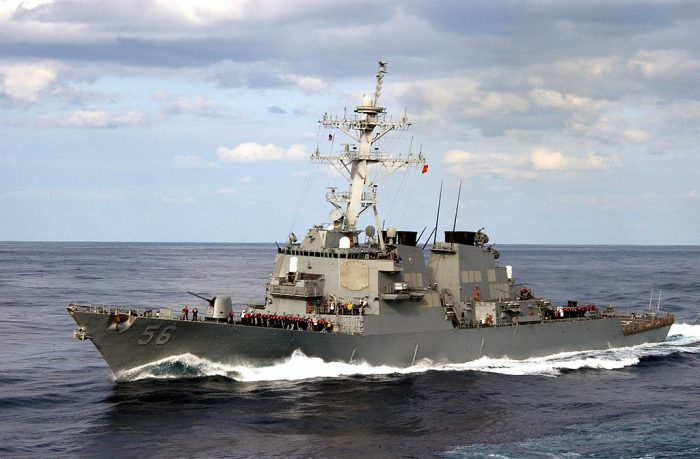
That point the US had argued that although one requires India’s consent for marine scientific analysis inside its EEZ, naval actions which may be performed within the EEZ past the territorial sea (of 12 nautical miles) should not topic to Coastal State regulation, that the Coastal State can not regulate hydrographic surveys or navy surveys performed past its territorial sea, and that it can not demand notification of such actions.
The differing interpretations of India and the US on the rights and obligations within the EEZ movement from the ambiguous wording in Article 58 of the UNCLOS that offers with EEZ.
It could be famous that whereas India ratified the UNCLOS in June 1995 (UNCLOS was concluded in 1982 and there are actually 168 nations events to it), the US has refused to accede to it to date.
Like India observing all the foundations of the nuclear non-proliferation with out changing into a signatory to both the NPT or the CTBT, the US says that it respects the UNCLOS like different pertinent worldwide legal guidelines.
Throughout the EEZ, the Coastal State enjoys, as allowed by the UNCLOS, sovereign rights for the aim of “exploring, exploiting, conserving and managing” residing and non-living pure sources, in addition to jurisdiction over most off-shore installations and buildings, marine scientific analysis, and the safety and preservation of the marine surroundings.
Coastal States don’t, nonetheless, train sovereignty over the EEZ like they do of their territorial waters. The time period “sovereign rights” in Article 56 of the UNCLOS was intentionally chosen to obviously distinguish between Coastal State’s useful resource rights and different restricted jurisdiction within the EEZ, and Coastal State’s authority within the territorial sea the place it enjoys a much wider and extra complete proper of “sovereignty”.
Article 58 of the UNCLOS says that within the EEZ, all States take pleasure in excessive seas freedoms of “navigation and overflight…laying of submarine cables and pipelines, and different internationally lawful makes use of of the seas associated to these freedoms, resembling these related to the operation of ships, plane and submarine cables and pipelines, and [which are] appropriate with the opposite provisions of the Conference”.
These “different internationally lawful makes use of of the seas” within the Article 58 have led to a gray space which is interpreted by the nations like america which quote another “pertinent worldwide legal guidelines” to say that the aforesaid actions could also be undertaken with out Coastal State discover or consent and that these actions embody a broad vary of navy actions resembling “intelligence, surveillance and reconnaissance (ISR) operations; navy marine information assortment and naval oceanographic surveys; battle video games and navy workout routines; bunkering and underway replenishment; testing and use of weapons; plane provider flight operations and submarine operations; acoustic and sonar operations; naval management and safety of shipping; institution and upkeep of military-related synthetic installations; ballistic missile protection operations and ballistic missile take a look at help; maritime interdiction operations (e.g., go to, board, search and seizure); standard and ballistic missile testing; belligerent rights in naval warfare (e.g., proper of go to and search); strategic arms management verification; maritime safety operations (e.g., counter-terrorism and counter-proliferation); and sea management”.
Nevertheless, nations like India (and 29 others like Bangladesh, Brazil, Myanmar, China, Indonesia, Iran, Kenya, Malaysia, Maldives, Mauritius, North Korea, Pakistan, the Philippines, Portugal, Syria, Thailand, Uruguay, and Vietnam) purport to manage or prohibit international navy actions within the EEZ by saying that the entire spirit behind the UNCLOS, significantly the Article 88, is that “The excessive seas shall be reserved for peaceable functions.”
In addition they say that Article 58, which preserves the liberty of navigation and overflight and the laying of submarine cables and pipelines and so forth for the maritime States, additionally underlines that these rights have to be exercised with “due regard to the rights and duties of the Coastal State,” and international maritime states “shall adjust to the legal guidelines and laws adopted by the Coastal State in accordance with the provisions of this Conference and different guidelines of worldwide regulation in as far as they don’t seem to be incompatible with Half V of the Conference that offers with EEZ”.
INS Sarvekshak, a hydrographic survey ship, is on a deployment to Mauritius for enterprise joint hydrographic surveys together with their Mauritian counterparts. https://t.co/BinYBgai63 pic.twitter.com/MNNDf5xUBw
— A. Bharat Bhushan Babu (@SpokespersonMoD) April 7, 2021
Plainly this divergence within the perspective regarding the legality of international navy actions within the EEZ between nations like India on the one hand and the USA on the opposite is just not being bridged due to the altering geopolitical elements. The speedy tempo of globalization, large improve in world commerce, rise within the dimension and high quality of the navies of many countries, and technological advances to use oceanic areas are having impacts on main militaries of the world.
The US officers argue that if the place of nations like India turns into the worldwide normal, almost 38 % of the world’s oceans that have been as soon as thought-about excessive seas and open to unfettered navy use will come beneath coastal state regulation and management.
And as soon as that’s accepted, then coastal states might deny navy entry to the entire South China and East China Seas, the Sea of Japan, and the Yellow Sea, that are house to a number of the world’s most strategic sea traces of communication.
On the identical time, the US additionally says that its navy workout routines or maneuvers in excessive seas are regular actions and people shouldn’t be construed as threats to the Coastal States, significantly pals like India.
However India is constrained to help such a place publicly, given the truth that it must be constant in its acknowledged place of not permitting irregular actions in its EEZ, beneath which its Navy had in 2019 pushed out a Chinese language survey vessel that had intruded into waters close to the Andaman and Nicobar Islands.
If the US can have a free run in India’s EEZ, how are you going to oppose that of China? This appears to be probably the most daunting query for the Indian policy-makers, happy with their strategic autonomy.