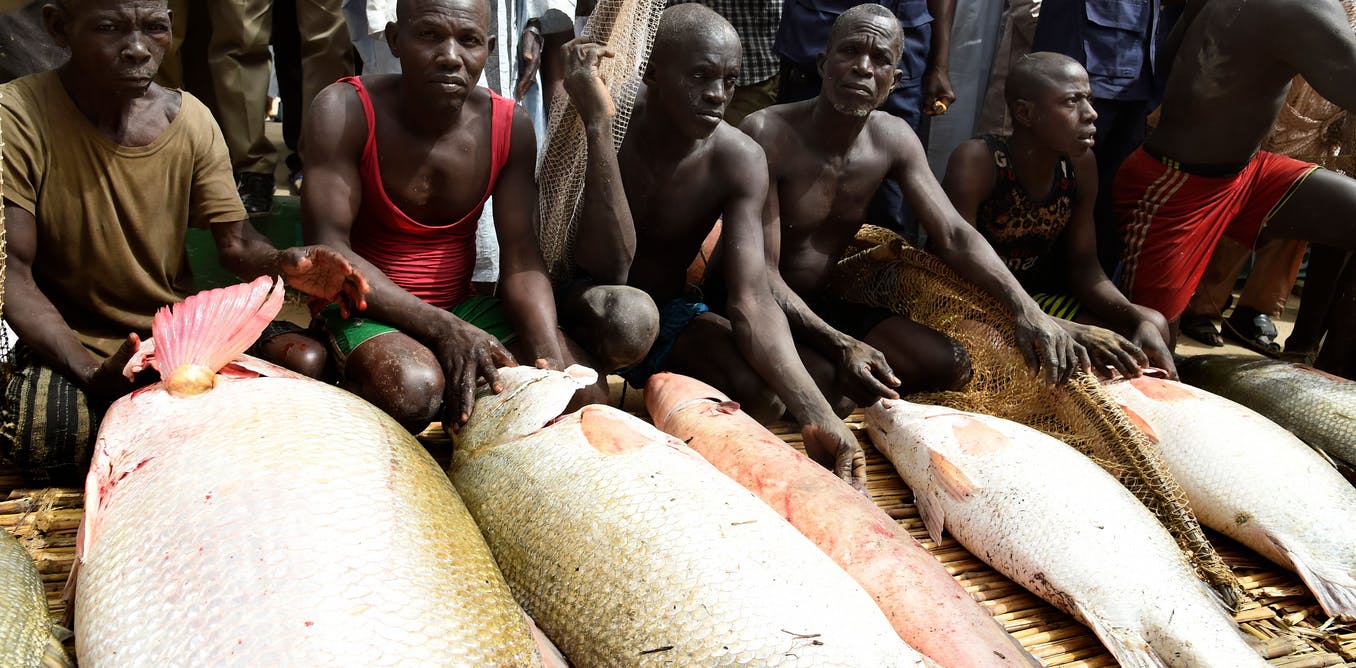
Like most international locations in West Africa, Nigeria’s coastal waters comprise numerous species of fish, which contribute to the food and economic security of its people.
Small-scale fishing operations contribute 80% of locally produced fish and support the livelihoods of 24 million Nigerians. Seventy three percent of these concerned in fisheries in Nigeria are ladies.
The general GDP contribution from fishing – small scale and industrial – was 0.84% in 2019 and 1.09% in 2020.
The fisheries sector is subsequently a path to socioeconomic improvement in Nigeria. But it surely additionally faces threats.
One in every of these is environmental pollution, primarily from the oil business. Air pollution degrades the maritime surroundings, destroys fish shares and reduces the catch.
One other menace is against the law fishing, as our previous research has discovered. Our present research continues to discover how ladies, particularly, are affected by and responding to those threats.
Step one is to grasp the size and complexity of unlawful fishing and related crime, and why it’s taking place.
Scale and prices
Just lately, the Nigerian Home of Representatives noted that the nation loses $70 million every year to unlawful fishing. This consists of lack of licence charges, income from taxation and the worth that might have been accrued from professional fishing by native vessels.
Different sources estimate the price of unlawful fishing in Nigeria as a lot larger, citing anyplace between $600 million and $800 million every year.
The variation in these figures reveals the difficulties in calculating the prices of clandestine exercise. It’s additionally a results of budgetary neglect of the Nigerian Federal Fisheries Division. The division lacks the capability to observe, survey and management vessels working in Nigeria.
Vessels from China, the European Union, and Belize are notable for illegally exploiting Nigerian waters.
Regardless of various estimates, all sources agree that the financial losses attributable to unlawful fishing in Nigeria are excessive. However the figures alone paint a superficial image of the true prices of unlawful fishing. Unlawful fishing doesn’t happen in isolation.
Fisheries crime
Fisheries crime denotes an enormous and numerous category of illegality and criminality that aids or accompanies unlawful fishing. Such crimes can embody corruption, customs fraud, human and medicines trafficking and piracy. Unlawful fishing and fisheries crime additionally threaten human rights.
Our previous research discovered that unlawful fishing was undermining individuals’s livelihoods. The shortage of presidency help to deal with unlawful fishing and defend livelihoods inside fishing communities additional pushes individuals into poverty. This makes them weak to criminal networks.
Fisherfolks might find yourself participating in, and being victimised by, fisheries crime in consequence. That is evidenced in growing criminality by rising incidents of piracy and armed theft at sea all through Nigeria’s coastal communities.
Maritime insecurity additionally has a gender dimension. Women in West African fisheries face distinctive challenges and dangers similar to poor entry to capital, rising competitors for entry to depleting fish shares, and coverage exclusion.
Neglect and poor laws
Regardless of the vital contribution that fishing makes to the livelihoods of Nigerians, authorities neglects this sector. That is evident within the marginal budgetary allocation the sector receives yearly.
The Monitoring, Management and Surveillance Division of Nigeria’s Federal Fisheries Division is essential to managing Nigeria’s fisheries. But no budgetary allocation has been made to it within the final 15 years.
The Monitoring, Management and Surveillance Division lacks patrol vessels, and is subsequently unable to observe the actions of vessels working in Nigeria. In 2017, the federal government announced plans to buy patrol vessels, however it hasn’t executed so but.
The sector doesn’t obtain sufficient funding to perform successfully. Nigeria’s Fisheries Division operates throughout the nation’s Federal Ministry of Agriculture and Rural Growth, which was allotted lower than 2% of the nationwide price range in 2019.
Current fisheries regulation can also be insufficient. Nigeria’s fisheries are ruled by the Sea Fisheries Act of 1992. These laws are outdated and ill-equipped to deal with the present scale and severity of rising fisheries crime.
For instance, in June 2020, a vessel, Hai Lu Feng 11, was fined ₦3 million (underneath $7,300) for switching off its Vessel Monitoring System whereas in Nigeria’s Exclusive Economic Zone.
The Vessel Monitoring System is designed to supply estimates of fishing exercise in close to actual time. Switching the system off suggests an intent to evade detection by the authorities. However this high-quality is tiny when contemplating the hundreds of thousands of {dollars} that unlawful fishing prices the Nigerian financial system every year.
Options to unlawful fishing
Fixing the issue of unlawful fishing in Nigeria requires that the Federal Division of Fisheries is supported to function successfully. Because the company charged to make sure the sustainable exploitation of Nigeria’s fisheries, it should be adequately funded.
Present fisheries laws should even be up to date to mirror the present realities and impacts of fisheries crime.
A holistic and collaborative strategy is essential to addressing fisheries crime. A nationwide maritime safety technique is required to information and facilitate inter-agency and regional cooperation. The technique ought to embody the institution of an information-sharing platform.
The seize of the pirates that focused Hai Lu Feng 11 vessel by the Nigeria navy was supported by the Fisheries Committee for the West Central Gulf of Guinea. This was by the regional on-line communications platform established underneath the West Africa Task Force.
This reveals that cooperation between fisheries businesses and different maritime enforcement businesses is essential to stemming the tide of unlawful fishing – and different crime at sea.