The worldwide financial system is predicted to develop by 4.7% this yr, quicker than predicted in September (4.3%), thanks, partially, to a stronger restoration in the USA, the place progress in distributing vaccines and a contemporary fiscal stimulus of $1.9 trillion are anticipated to spice up shopper spending, says a new UNCTAD analysis.
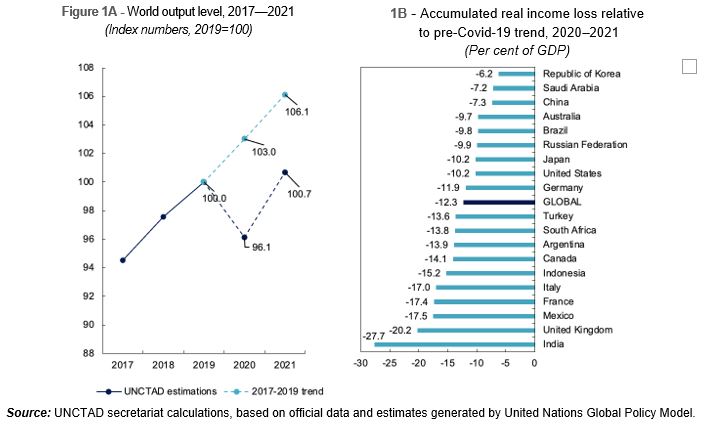
However this may nonetheless go away the worldwide financial system over $10 trillion wanting the place it might have been by the top of 2021 if it had stayed on the pre-pandemic development (Determine 1) and with persistent worries in regards to the actuality behind the rhetoric of a extra resilient future.
The evaluation entitled “Out of the frying pan …Into the fireplace” is UNCTAD’s Commerce and Growth Report replace launched on 18 March.
“V” is for susceptible
The brunt of the hit to the worldwide financial system is being felt in growing international locations with restricted fiscal area, tightening steadiness of funds constraints and insufficient worldwide assist, in keeping with UNCTAD. And whereas all areas will see a turnaround this yr, potential draw back well being and financial dangers might nonetheless produce slippages.
Trying additional forward, the report says atavistic financial dogmas, weak multilateral cooperation and a widespread reluctance to sort out the issues of inequality, indebtedness and inadequate funding – all worsening because of COVID-19 – recommend that, with no change in fact, an unbalanced restoration, vulnerability to additional shocks and protracted financial insecurity will grow to be the brand new regular for a lot of.
Describing 2020 as an “annus horribilis”, UNCTAD acknowledges that issues might have been worse.
A mixture of preemptive Central Financial institution motion to keep away from a monetary meltdown, swift and sizeable reduction packages in superior international locations, a bounce-back in capital flows and commodity costs and the unprecedented fast-tracking of vaccine growth all helped to keep away from an much more vicious deflationary spiral taking maintain.
Nonetheless, the affect of those actions has been uneven with Okay-shaped recoveries rising inside and throughout international locations. Creating international locations have skilled among the largest private earnings drops relative to GDP.
In international locations the place poverty ranges are already excessive and huge components of the labour drive are working in casual jobs, the instant affect of even a small downturn in financial exercise might be devastating, with the World Financial institution estimating 1 / 4 of a billion extra individuals sliding into poverty (on a $3.20 day by day benchmark) because of the pandemic.
Worldwide cooperation wanting
Regardless of the size of the worldwide well being and financial disaster, worldwide cooperation has fallen properly brief of what’s wanted.
The report compares the $12 billion of suspended debt servicing (for the yr June 2020 to June 2021) for the 46 international locations collaborating within the G20’s Debt Service Suspension Initiative (DSSI) to the $80 billion in debt service funds in 2019 by the 73 eligible DSSI international locations and over a trillion {dollars} for all growing international locations.
Equally, the refusal by superior international locations to assist a waiver on trade-related features of mental property rights (TRIPS) on the World Commerce Group to assist enhance vaccine availability has signalled a precedence of earnings over individuals within the combat in opposition to the pandemic.
The worldwide restoration that started within the third quarter of 2020 is predicted to proceed by means of 2021, albeit with a great deal of unevenness and unpredictability, reflecting epidemiological, coverage and coordination uncertainties.
UNCTAD sees a misguided return to austerity after a deep and harmful recession as the principle danger to its international outlook, particularly within the context of fractured labour markets and deregulated monetary markets in superior economies.
However even barring a direct return of austerity, the report notes, it is going to take multiple yr for output and employment to return to their pre-COVID-19 ranges in most international locations with employment, earnings inequality, and public welfare over the medium time period relying on the evolution of coverage responses.
However the report warns that COVID-19 will probably have lasting financial, in addition to well being penalties, which would require continued authorities assist.
Previous habits die onerous
The report sees indicators that rising development methods submit COVID-19 internationally are reverting to their pre-crisis norm, with an undue emphasis on exports in components of East Asia and Western Europe, unfastened financial coverage and asset-fuelled consumption in the USA, and reliance on non-public capital inflows and commodity exports in Africa and Latin America.
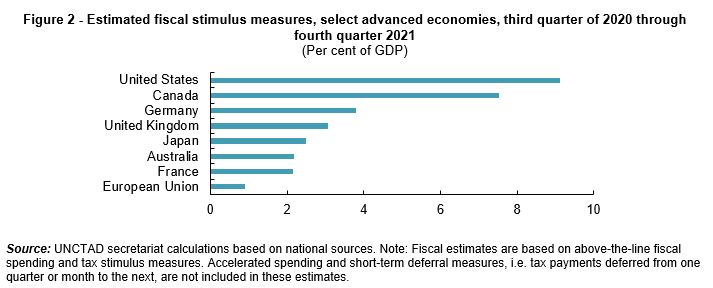
The $1.9 trillion stimulus bundle in the USA is grounds for encouragement. Nonetheless, whereas the bundle accommodates massive money transfers, there may be a lot much less direct spending on consumption and funding, which might provide the most secure path to combination demand enlargement and a inexperienced transition. This makes the complete impact of the bundle unsure.
Extra troubling, in keeping with the report, different superior international locations are lagging far behind (Determine 2).
There are additionally indicators that the brand new administration in the USA is extending its efforts to the multilateral degree, endorsing a $500 billion issuance of recent particular drawing rights to assist international liquidity on the upcoming G20 assembly, beforehand blocked by the Trump administration.
It is a welcome transfer however, in keeping with UNCTAD, the size of the debt risk, significantly for growing international locations, can’t be decreased with out debt forgiveness and the adoption of a functioning debt exercise mechanism.
The report concludes that tackling the mutually reinforcing traits of rising inequality, mounting debt misery, indifferent monetary markets and rising market energy of huge companies reluctant to reinvest their earnings in constructing productive capacities would require greater than a one-shot financial stimulus.
It requires a extra wholesale rewriting of the principles of the financial sport if the errors of the 2009 monetary disaster are to not be repeated and the purpose of an inclusive, sustainable and resilient international financial system realized by 2030.