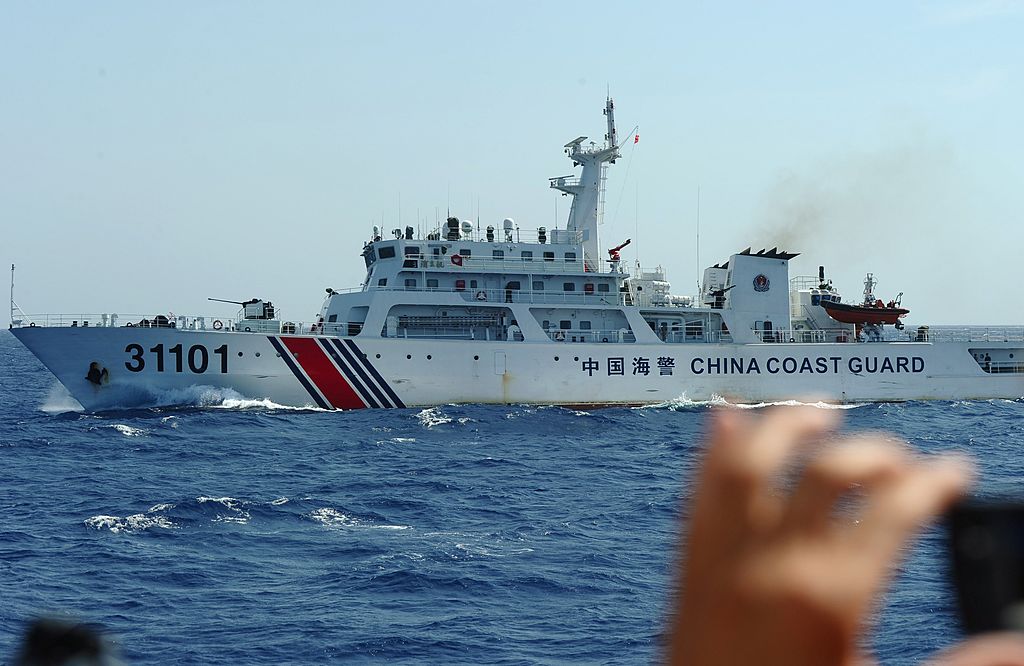
Since its October launch in draft form, China’s new coastguard law has been the topic of dozens of news reports and analyses. Maritime legislation enforcement laws hardly ever attracts such worldwide consideration, however on this case it’s warranted. For 15 years, the China Coast Guard has led the nation’s seaward expansion into areas lengthy claimed however seldom (if ever) visited. Worldwide observers are proper to surprise, what does the brand new legislation portend for Chinese language behaviour at sea?
Many have focused on the legislation’s use-of-force provisions. Previously, the China Coast Guard has employed a variety of coercive ways to realize Beijing’s strategic and operational targets. Final April, as an illustration, a 3,500-ton Chinese language coastguard ship rammed and sank a Vietnamese fishing vessel working in waters additionally claimed by Hanoi (Beijing implausibly suggested the wooden-hulled Vietnamese boat did the ramming). Nevertheless, to this point it has averted utilizing armed drive towards foreigners.
The brand new legislation alerts that that would change. Article 47 authorises armed China Coast Guard personnel to forcibly board noncompliant overseas vessels ‘illegally’ engaged in financial actions in Chinese language-claimed waters. Article 48 permits the usage of shipborne weapons (that’s, deck weapons) in instances the place coastguard forces face assault by weapons and ‘different harmful strategies’—which might imply something. Much more ambiguous, Article 22 permits the coastguard to make use of ‘all means essential together with the usage of drive’ to cease foreigners discovered infringing Chinese language ‘sovereignty, sovereign rights and jurisdictional rights.’
Whereas disturbing, the use-of-force provisions are usually not essentially the most worrisome components within the new legislation. Somewhat, it’s the ambiguous geographic scope of the legislation’s software: China’s ‘jurisdictional waters’ (管辖海域). The draft legislation solely vaguely outlined the time period (Article 74). Within the closing model, handed on 22 January, that content material was eliminated, leaving no definition in any respect.
Nevertheless, a detailed studying of authoritative Chinese language sources reveals that Beijing claims jurisdiction over 3 million sq. kilometres of maritime house, usually known as China’s ‘blue national territory’. This includes the Bohai Gulf; a big part of the Yellow Sea; the East China Sea as far east because the Okinawa Trough, together with waters across the disputed Senkaku/Diaoyu Islands; and all of the waters inside the ‘nine-dash line’ within the South China Sea. By Beijing’s personal reckoning, ‘over half’ of this house is contested by different nations.
If the China Coast Guard adopted the letter of the brand new legislation, what would we see? Within the South China Sea, any overseas fishing, survey or analysis vessel discovered working wherever inside the nine-dash line could be topic to boarding and inspection (Article 18). Refusal to conform would imply a forcible boarding by armed personnel ready to compel them to take action (Article 47). The China Coast Guard would ship items to dismantle the constructions on each Vietnamese-, Philippine- and Malaysian-occupied land function within the Spratly Archipelago (Article 20). Within the East China Sea, the coastguard would sail to the Senkaku/Diaoyu Islands and ‘expel’ each Japanese ship it encountered (Article 17). Within the Yellow Sea, East China Sea and South China Sea, the coastguard would observe down and evict US Navy ocean surveillance ships like USNS Impeccable and hydrographic survey ships like USNS Bowditch for conducting ‘unlawful’ actions in China’s unique financial zone (Article 21).
Thankfully, simply because Beijing has a legislation on the books doesn’t imply that it’s going to really implement its provisions. That is definitely true within the maritime realm. For instance, China’s nationwide fisheries legislation, final updated in 2013, authorises China’s maritime legislation enforcement forces to punish and expel (Article 46) overseas fishing vessels working illegally in China’s jurisdictional waters. But there stay huge sections of China’s ‘blue nationwide territory’ the place they proceed to function unmolested.
Lately, China has adopted a number of new legal guidelines and laws that appeared to presage new coercive behaviour that by no means occurred. For instance, in 2012 and 2013 Hainan province issued two new maritime legal guidelines, one on fisheries management and one on public security. Nether has apparently made issues worse for overseas mariners, regardless of concerns they might.
In August 2016, the Chinese language supreme court docket issued judicial interpretations authorising the China Coast Guard to cost foreigners for legal offences if caught ‘poaching’ in Chinese language jurisdictional waters. Since then, the coastguard has not enforced this provision, regardless of many possibilities to take action. Thus, new legal guidelines haven’t essentially meant new coercive behaviour. It appears unlikely that this one will both.
Why? As a result of imposing these legal guidelines towards overseas mariners is above all a political determination. It’s a query of overseas coverage, not home coverage. And making use of them by the e-book could be horrible overseas coverage. Beijing would additional alienate its neighbours, pushing them nearer to its rivals, the US and Japan. It will make it a lot more durable for Malaysia, Indonesia and Vietnam to stay impartial within the present interval of great-power competitors. It will danger erasing all of the laborious work finished to lure Manila away from its alliance with Washington. And it will imply struggle with Japan and the US.
This doesn’t imply that regional states ought to merely ignore the coastguard legislation. Removed from it. When the draft was issued in October, an official ‘explanation’ listed 4 the explanation why it was urgently wanted. The primary cited necessities related to constructing China right into a ‘maritime nice energy’ and ‘safeguarding maritime rights and curiosity’—the code phrases for ‘do a greater job defending China’s maritime claims’.
Clearly, Beijing expects the legislation to learn its trigger ultimately. Furthermore, Chinese language policymakers inserted essentially the most coercive provisions within the new legislation as a result of they clearly imagined conditions when making use of them would make political sense. So, even when the probabilities of a significant new provocation are small right this moment, regional states should take substantive steps to organize for that risk sooner or later.
Good leaders will do greater than that. In June 2012, Vietnam handed a new maritime law that outlined the geographic extent of its personal maritime boundaries, together with territories occupied by China. In retaliation, China established Sansha City, opening the door to main enlargement of Chinese language administration of disputed house within the South China Sea. If China can take overseas laws significantly, so can others.
Apart from being vigilant and shrewd, what else would possibly regional states do? On the very least, they need to inform Beijing that they may by no means settle for the legislation’s software towards their residents in disputed waters and warn of extreme penalties if China does so anyway. Within the age of great-power competitors even small states have leverage. They need to additionally demand that China present a exact definition of its ‘jurisdictional waters’.
In authorising its coastguard to make use of lethal drive to uphold its maritime claims, Beijing has crossed a line. Overseas diplomats ought to inform their Chinese language counterparts that ambiguity of any variety is solely not acceptable.