On 1 June, the European Funding Financial institution (EIB) and European Fee revealed a brand new research on the state of play in synthetic intelligence and blockchain applied sciences within the European Union: “Synthetic intelligence, blockchain and the way forward for Europe: How disruptive applied sciences create alternatives for a inexperienced and digital economic system.” The research was produced by the EIB’s Innovation Finance Advisory workforce in shut collaboration with DG CONNECT underneath the InnovFin programme – a joint EIB and European Fee initiative to help Europe’s innovators.
Learn the net abstract here
Obtain the complete research here
Synthetic intelligence and blockchain applied sciences have the potential to revolutionise the way in which we work, journey, chill out, and organise our societies and day-to-day lives. Already in the present day, they’re enhancing our world: synthetic intelligence was essential in rushing up the event and manufacturing of COVID-19 vaccines, whereas blockchain has the potential to not solely disrupt the monetary system, but additionally assist us observe and report greenhouse gasoline emissions higher, optimise industrial transport and create real knowledge privateness safety. The additional improvement of each applied sciences – guided by moral and sustainability ideas – has the potential to create new pathways for our progress, driving technological options to make our societies actually digital and greener, and finally maintain the planet liveable.
The report launched in the present day reveals that compared to main world opponents, the European Union is falling behind in growing and deploying synthetic intelligence and blockchain applied sciences. To catch up, nonetheless, the European Union can construct on its main function in high-quality analysis and its huge pool of digital expertise.
“The true added-value of synthetic intelligence and blockchain nonetheless lies forward of us – in industrial, enterprise and public purposes. That is the place Europe can catch up and even take the lead,” mentioned EIB Vice-President Teresa Czerwińska, who’s liable for the EIB’s innovation investments. ”On the identical time, we have to guarantee that the event of those applied sciences is targeted and respects our European values. We have to improve our joint efforts. To make this occur, our research reveals that amongst different issues, we have to make investments extra and quicker, particularly in later-stage startups. With the EIB Group, EU international locations have the best instrument at hand to spice up and scale up the event of data-driven options, convey excellence in analysis to the market and assist construct a greener, smarter society and thus a stronger Europe.
“AI and blockchain applied sciences are essential for fostering improvements, competitiveness, and sustainable financial progress. They provide unprecedented alternatives as key enablers of the digital and inexperienced transformation. It’s thus important to spice up investments in each the event and adoption of those breakthrough applied sciences in Europe,” mentioned Roberto Viola, Director Basic of DG CONNECT, Directorate Basic of Communication, Networks, Content material and Know-how, on the European Fee.
Is the European Union maintaining within the world synthetic intelligence and blockchain race?
The research reveals that the best variety of small and medium-sized enterprises (SMEs) concerned in synthetic intelligence and blockchain will be present in the US (2 995), adopted by China (1 418) and the EU27 (1 232). The UK is one other notable participant (495). Inside the EU27, the best variety of corporations is positioned in Germany and Austria, adopted by southern Europe, France and central, japanese and south-eastern Europe (EU13).
For accessible financing, it already appears to be a two-horse race between the US and China: collectively they account for over 80% of the €25 billion in annual fairness invested in synthetic intelligence and blockchain applied sciences, whereas the EU27 solely accounts for 7% of this whole, investing round €1.75 billion per 12 months. Total, in response to the research, the estimated funding hole in synthetic intelligence and blockchain applied sciences in Europe might be as a lot as €10 billion yearly.
One clarification for this hole is the restricted function performed by giant institutional traders equivalent to pension funds, insurers and endowments in financing later-stage startups concerned in synthetic intelligence and blockchain.
Geographic breakdown of synthetic intelligence and blockchain smaller and medium-sized corporations, 2020
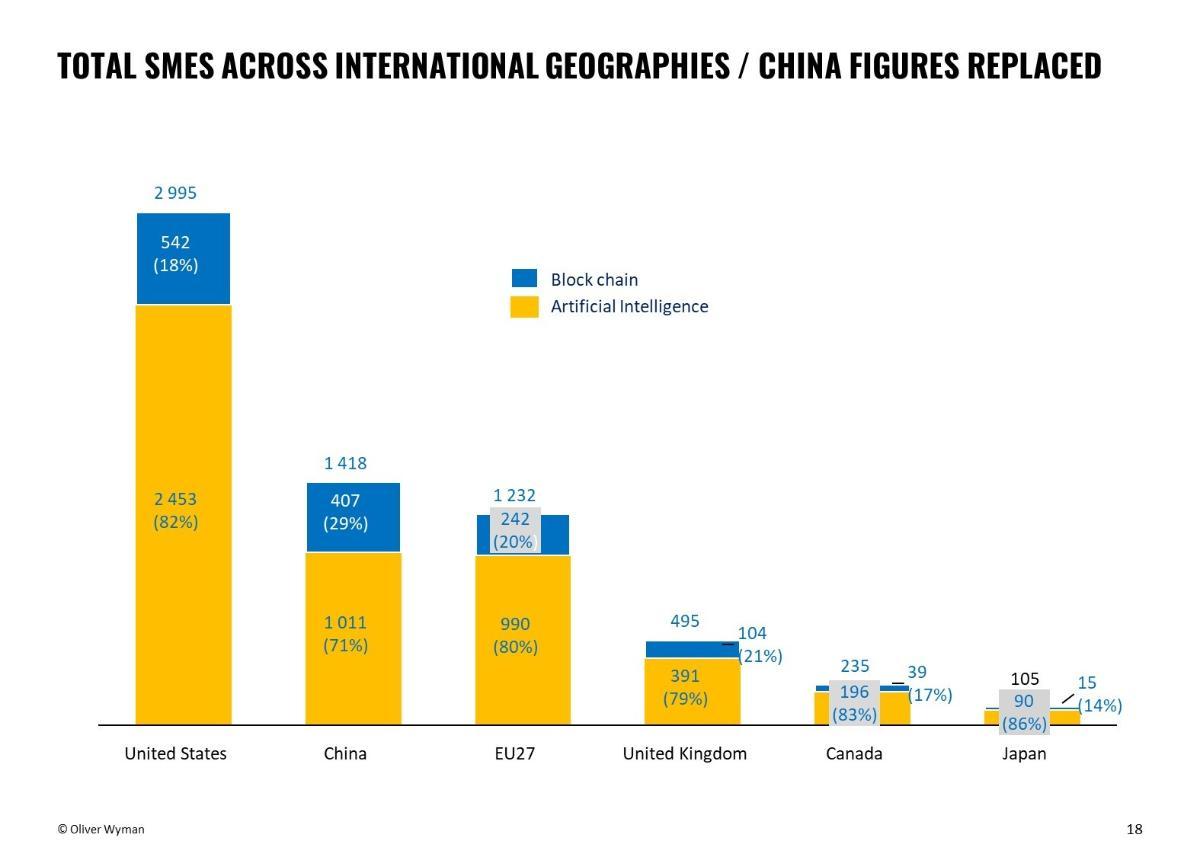
Supply: Crunchbase knowledge, Oliver Wyman evaluation
Can the European Union catch up?
The research reveals that the enterprise surroundings general within the EU27 harbours sturdy potential for competing with the US and China. The EU27 has extra specialised researchers than its friends, and sometimes produces essentially the most technology-related tutorial analysis. Some Member States are performing strongly within the digital phase, indicating that the area is in an excellent place to deploy synthetic intelligence and blockchain applied sciences throughout completely different sectors.
Europe additionally has the most important expertise pool of researchers in synthetic intelligence, with an estimated 43 064 within the discipline (of whom 7 998 are in the UK), in contrast with 28 536 in the US and 18 232 in China.
What ought to the European Union do to catch up?
The research identifies three main areas that have to be addressed in Europe’s synthetic intelligence and blockchain panorama. The challenges embody improvement, market deployment and the broader EU innovation ecosystem. Accordingly, extra financing must be made accessible for growing and scaling up EU companies. It highlights the necessity of joint European efforts to pool monetary assets from the private and non-private sector to help the scale-up of essentially the most modern AI and blockchain ventures in Europe. The deployment of each applied sciences additionally must be supported by backing their take-up available on the market. And to develop additional, Europe’s innovation hubs have to be higher related to extend the circulation of expertise, expertise and funding entry.
Learn the detailed suggestions and the complete report here
Explainer: What are synthetic intelligence and blockchain?
Synthetic intelligence, because the time period tends for use in the present day, is the idea and follow of constructing machines able to performing duties that appear to require intelligence. At the moment, cutting-edge applied sciences striving to make this a actuality embrace machine learning, synthetic neural networks and deep studying.
Blockchain is actually a brand new submitting system for digital info, which shops knowledge in an encrypted, distributed ledger format. It’s a clear and decentralised means of recording lists of transactions. As a result of knowledge are encrypted and distributed throughout many various computer systems, it allows the creation of tamper-proof, extremely sturdy databases, which will be learn and up to date solely by these with permission.
The alternatives offered by each applied sciences are very more likely to be mixed to create new merchandise, providers, belongings and even types of governance. Synthetic intelligence will be seen right here because the “considering” half, and blockchain because the “remembering” half.
Background info
The EIB is certainly one of Europe’s largest financiers of innovation, with investments in innovation, digitalisation and human capital of greater than €230 billion since 2000. The EIB Group invested over €2 billion in AI core applied sciences and AI associated purposes, digital networks and tasks prior to now two years. The EIB additionally helps investments past the European Union.
Concerning the InnovFin programme
InnovFin – EU Finance for Innovators is a joint initiative launched by the European Funding Financial institution Group (EIB and EIF) in co-operation with the European Fee underneath Horizon 2020. InnovFin goals to facilitate and speed up entry to finance for modern companies and different modern entities in Europe. Please click here for the accessible merchandise underneath the InnovFin programme.
InnovFin Advisory helps eligible private and non-private counterparties to enhance the bankability and investment-readiness of huge, advanced, modern tasks that want substantial long-term investments.