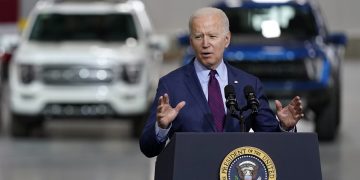


President Joe Biden’s first detailed federal budget is slated to be launched on Might 28, and it’ll embrace substantial increases in spending to combat local weather change.
An overview despatched to Congress included $10 billion in nondefense spending on clear power innovation — a 35% improve over 2021. How Congress responds to the main points popping out now, notably the proposed investments in local weather analysis and growth, will be crucial to the nation’s and the world’s means to decrease emissions.
Biden’s vision of a cleaner future — with greenhouse fuel emissions falling to net-zero by 2050 — won’t be possible with out dramatically improved expertise.
For instance, proper now there aren’t any applied sciences able to be deployed on a world scale to get rid of emissions from many important agricultural and industrial actions. Three examples are animal agriculture, cement manufacturing and metal manufacturing, which collectively account for over 1 / 4 of all world emissions.
My research career has been dedicated to innovation coverage, and I served on the White Home workers beneath President Barack Obama. I’ve seen how good public insurance policies and savvy federal investments may help speed up the innovation course of.
Progress, however yawning gaps
There’s no query that the world is making progress on clear power. Wind and solar power costs have fallen dramatically, permitting them to displace coal and pure fuel in lots of places to supply a lot cleaner electrical energy. Electrical autos are becoming mainstream as nicely.
However as promising as these applied sciences are, they may nonetheless depart the world far wanting net-zero emissions, even when they proceed to develop quickly.
The Worldwide Vitality Company, whose members embrace the world’s largest economies, developed a mannequin to indicate how the world can get to net-zero emissions by 2050 whereas making certain a fundamental lifestyle for all folks. The mannequin incorporates greater than 400 applied sciences and charges them by their present readiness stage.
It discovered that just about half the emissions reductions between now and 2050 would come from applied sciences which are both nonetheless within the prototype section or simply being demonstrated. One other 40% would come from applied sciences which have just lately entered the market and haven’t essentially reached full price parity with standard assets. Most different power and local weather system modelers attain comparable conclusions.
Innovation is especially important for the hard-to-decarbonize sectors. For instance:
Cement, the world’s most generally used materials, causes about 8% of worldwide emissions. It’s usually produced in kilns which are fired to very excessive temperatures with pure fuel. It additionally undergoes a chemical response that releases carbon dioxide. Rising options embrace capturing the carbon throughout manufacturing, shifting to low-carbon supplies and inventing new processes altogether. However none of those choices is prepared but to scale as much as meet the problem of dramatically decreasing emissions at an affordable price.
Steel, which produces 7% of worldwide emissions, has comparable challenges and options, with specific emphasis on utilizing hydrogen within the manufacturing course of. In Sweden, as an illustration, the HYBRIT (Hydrogen Breakthrough Ironmaking Expertise) demonstration plant will use hydrogen produced via electrolysis, which splits water into hydrogen and oxygen to keep away from emissions. It’s nonetheless costly, although. Manufacturing costs have been estimated to be 20%-30% greater than standard strategies.
Animal agriculture is the supply of 12% or extra of worldwide emissions. Livestock and manure emit methane, a potent greenhouse fuel. Fossil fuels and fertilizers are additionally used to develop feed crops, and forests could also be destroyed to accommodate grazing. These challenges require a unique set of options, which could embrace new practices for managing soil, changing livestock feed and inventing substitutes for conventional meat, together with decreasing meat consumption.
Aviation — answerable for 2% of worldwide emissions — requires high-powered engines to supply thrust over a brief time period. That power demand is tough to satisfy with batteries in comparison with gas combustion, particularly for long-haul flights. Whereas some entrepreneurs are pursuing electric planes, different prospects for emissions-free flights might embrace making liquid fuels from biological sources or from hydrogen and captured carbon.
Maritime shipping, at present 2% of emissions, might also swap to sustainable liquid fuels or hydrogen-powered fuel cells to drive electrical motors. Port operations, which depend on heavy vans and gear for transferring freight, would require comparable options.
Placing all of it collectively
The argument for innovation isn’t an argument towards deployment of local weather options that already work. Deployment spurs innovation. That’s how wind and photo voltaic grew to become cheaper, and why electrical autos are prone to comply with swimsuit as extra of them get on the highway.
However evidence shows that targeted policies will be essential to speed up innovation in sectors that now lack them.
Firms will hardly ever attempt to resolve local weather challenges with their very own cash as a result of the payoff is simply too distant and unsure. Authorities regulation and charging firms a price in the event that they emit greenhouse gases might assist shut a part of the innovation hole, however it isn’t an alternative to public investments in innovation.
Gasoline taxes present an analogy. They’ve for many years been a lot greater in Europe than in america. Because of this, European automobile sellers provided smaller and extra environment friendly automobiles than did their American counterparts. However till very just lately, no European carmaker provided EVs. It took targeted insurance policies, like Norway’s giant authorities incentives, in addition to the startup Tesla’s ingenuity — which was aided by U.S. federal and state insurance policies — for the EV market to take off.
Issues are trying up
Heeding the proof, the Biden administration has promised to quadruple clear power analysis in 4 years, and its infrastructure proposal contains quite a few large-scale power and local weather expertise demonstration initiatives.
On the latest global leaders’ summit on climate change, Biden additionally introduced a revival of Mission Innovation, a world initiative arrange in parallel with the Paris local weather settlement to spark private and non-private funding.
Though local weather coverage is very polarized in america, innovation receives widespread support. Massive majorities from each events endorse it in public polls. So do organizations starting from Green New Deal advocates to the tax- and regulation-averse U.S. Chamber of Commerce.
Innovation is usually a sluggish, complicated course of, because the decades-long story of renewable power growth exhibits. It’s now up to Congress to move a funds that can transfer local weather innovation sooner. The increasing impact of rising temperatures exhibits there is no such thing as a time to waste.
This text is republished from The Conversation beneath a Artistic Commons license. Learn the original article.